Week 27: Recognizing and Drawing Shapes · Point of View in Literature

    Quarter 3 · Detailed day-by-day lesson plans · Days 131–135

    0 of 15 lessons done this week

    Recognizing and Drawing Shapes Point of View in Literature

    Print

    Worksheets and answer keys

    Gather this week

    • Shop
    • Shop
    • Shop
    Everyday supplies (9)

    Writing prompt

    • Pick a book you love. Convince a friend to read it.
    Week 27 writing prompts

    Parent note

    This week's parent digest

    Specials this week

    Supplements

    This week at a glance

    Week 27 identifies and draws shapes by attribute — sides, angles, vertices — and counts the faces, edges, and vertices of a cube. In ELA, children explore point of view in literature and add temporal words to narrative writing.

    Parent tip

    Hunt for shapes around the house and count their sides.

    Materials this week

    Geoboards or rubber bands, narrative draft

    Mathematics

    Recognizing and Drawing Shapes

    Data & Geometry · 2.MD.D.9

    Assessment: Identify and draw triangles, quadrilaterals, pentagons, hexagons by attributes

    ELA

    Point of View in Literature

    Phonics: Review r-controlled vowels

    Writing: Narrative with temporal words; closure

    Science

    Biodiversity & Interdependence

    2-LS2-1, 2-LS2-2, 2-LS4-1

    Social Studies

    Economics: Needs, Wants & Choices

    Monday — Day 131

    140 minutes of instruction

    Math

    Students will identify triangles, quadrilaterals, pentagons, and hexagons by counting sides and vertices (2.G.A.1).

    Standards Addressed

    Activities

    10 min

    Warm-Up

    Spiral from Week 26: draw a small bar graph with squares 3, triangles 5, circles 2 and ask, 'How many more triangles than circles?' Then ask, 'What makes a triangle a triangle?' and listen for the number three.

    15 min

    Mini-Lesson

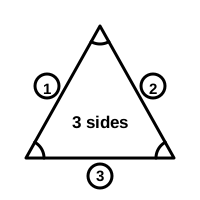
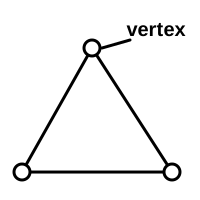
    Draw a triangle, a quadrilateral, a pentagon, and a hexagon. For each, trace the sides with a finger while counting, then tap and count the vertices, the corners where two sides meet. Write the name and both counts under each: triangle 3 and 3, quadrilateral 4 and 4, pentagon 5 and 5, hexagon 6 and 6.

    15 min

    Practice

    Your child builds each shape with toothpicks or straws on the table, using one stick per side, and records sides and vertices in a table. Then they make a wobbly, stretched version of each and confirm the counts stay the same.

    5 min

    Wrap-Up

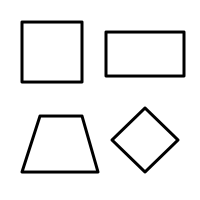
    Ask, 'Is a square a quadrilateral? Is a rectangle?' Guide your child to say yes because both have 4 sides and 4 vertices.

    Materials Needed

    toothpicks or strawspaperpencil

    English Language Arts

    Students will identify the different points of view of the kid and the ant in 'Hey, Little Ant' and begin revising their recount with temporal words (RL.2.6, W.2.3).

    Standards Addressed

    Activities

    15 min

    Read-Aloud: Hey, Little Ant

    Say: 'Last week you built on each other's ideas. This week we listen to two characters who disagree.' Read 'Hey, Little Ant' by Phillip and Hannah Hoose with two voices: you read the kid and your child reads the ant. Stop at the final question about what the kid should do and do not answer it yet.

    Hey, Little Ant by Phillip and Hannah Hoose
    10 min

    Mini-Lesson: Point of View

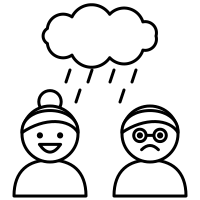
    Explain that point of view means who is talking and what that character wants. Make a two-column chart: 'The kid wants ___ because ___' and 'The ant wants ___ because ___' and fill each with two reasons from the text (the ant has a family and a job; the kid says his friends would laugh).

    chart papermarker
    15 min

    Guided Reading: Best Argument

    Reread the book, switching voices so your child now reads the kid. Your child picks the single strongest argument from each character and reads it in that character's voice, then you hold a stem conversation on 'Who makes the better point?'

    Hey, Little Antstem chart
    15 min

    Writing Workshop: Temporal Words

    Pull the Week 25 recount out of the folder. Post a chart of temporal words: first, next, then, after that, later, meanwhile, finally, at last. Your child rereads the draft, circles any time words already there, and adds at least three more so a reader can follow the order.

    recount draftchart papermarkerpencil
    10 min

    Phonics: R-Controlled ar

    Word cards: car, farm, star, park, yard, shark, garden, market, sharp, harm, start, barn. Remind your child that 'bossy r' changes the vowel sound, read the pile, and connect 'market' to Market Street. Your child writes four words and underlines 'ar' in each.

    index cardsmarkerwriting notebook

    Materials Needed

    Hey, Little Ant by Phillip and Hannah Hoosechart papermarkerstem chartrecount draftpencilindex cardswriting notebook

    Science

    Students will observe that plants need sunlight and water to grow and begin to explain that animals depend on plants for food and shelter (2-LS2-1, 2-LS2-2).

    This week's reading: Living Things Need Each Other

    Standards Addressed

    Activities

    5 min

    Science Question of the Week

    Look at last week's Animal Groups Poster. Ask: 'What would happen to every animal on this poster if all the plants disappeared?' Let your child think out loud. Write the week's question: 'How do living things depend on each other?'

    20 min

    Investigation: Bean Sprout Sun-and-Water Test

    Set up four clear cups labeled A to D, each with a wet paper towel and 3 dried beans pressed against the side. A: sunny window, water daily. B: sunny window, no more water. C: dark closet, water daily. D: dark closet, no water. Your child predicts which will sprout and draws the setup. While waiting for sprouts, cut open an apple and a bell pepper and find the seeds; discuss that the fruit is the plant's way of getting animals to carry seeds.

    4 clear cupspaper towels12 dried beanswatermasking tape and markerapplebell pepperknife (adult)
    5 min

    Wrap-Up

    Say: 'Plants need sun and water. What do animals need from plants?' List food, shade, homes, and oxygen on an index card. Set a reminder to check and water cups A and C daily.

    Materials Needed

    4 clear cupspaper towels12 dried beanswatermasking tape and markerapplebell pepperknife (adult)index card
    Open Monday on its own page
    Science

    Reading About Our World: Living Things Need Each Other

    Read it aloud first while your child follows along. Then read it together, and let your child read the parts they can. Talk about the words in the word box.

    No plant or animal lives all alone. The living things in a place need each other.

    Animals need plants. Rabbits and deer eat plants. Birds build nests in trees. Many insects live on leaves and stems.

    Plants need animals too. Bees visit flowers to drink nectar. As they fly from flower to flower, they carry pollen. Pollen helps plants make seeds.

    Squirrels bury nuts to eat later, but they do not find all of them. Some of those nuts grow into new trees.

    Some animals eat other animals. An owl eats mice. A robin eats worms.

    Even dead plants and animals help. Worms and fungi, like mushrooms, break them down into soil. New plants grow in that soil.

    Look outside. Can you find a plant and an animal that help each other?

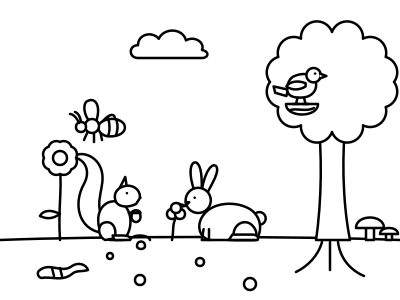
    Living things helping each other: a bee visits a flower, a squirrel buries a nut, a rabbit eats clover, a bird sits in its nest, and a worm and mushrooms work in the soil.

    Word box

    pollen:
    a yellow powder in flowers that helps plants make seeds
    nectar:
    a sweet liquid inside flowers
    bury:
    to put something in the ground and cover it
    fungi:
    living things like mushrooms that break down dead plants and animals

    Questions

    1. How do bees help plants?
    2. How can a squirrel help a new tree grow?
    3. What do worms and fungi do with dead plants and animals?

    Weekly check

    Math

    Weekly Check

    • I can name triangles, quadrilaterals, pentagons, hexagons and cubes by counting sides, corners or faces.
    • I can draw a shape with a given number of sides.
    1. I have 4 sides and 4 vertices. What shape am I?
    2. I have 5 sides. What shape am I?
    3. How many vertices does a triangle have?
    4. How many sides does a hexagon have?
    5. Draw a shape with 6 sides.
    6. How many faces does a cube have?

    ELA

    Weekly Check

    • I can tell how characters see things differently.
    • I can read words with ar, or, er, ir and ur.

    Park or Paint?

    Carla wants to go to the park. "The sun is out, and I want to run," she says. Her brother Burt wants to stay home. "I want to paint a bird for Mom," he says.

    1. What does Carla want? Why?
    2. What does Burt want? Why?
    3. How do Carla and Burt see the day differently?
    4. Write two words from the story with ar or ur.
    5. Sort: fork, fern, dirt. Write the r-controlled team in each.

    Science

    Weekly Check

    • I can explain how plants and animals need each other.
    • I can give an example of an animal helping a plant spread pollen or seeds.
    1. Name one thing animals get from plants.
    2. How does a bee help a flower?
    3. How does a flower help a bee?
    4. A dog walks through a field. Seeds stick to its fur and drop off far away. What did the dog do for the plant?
    5. What two things do bean plants need to grow?

    Social Studies

    Weekly Check

    • I can explain that producers make goods or give services, and consumers buy or use them.
    • I can explain that one person can be both a producer and a consumer.
    1. What is a producer?
    2. What is a consumer?
    3. A farmer grows apples. Is the farmer a producer or a consumer?producerconsumer
    4. Liam buys a toy at the store. Is he a producer or a consumer?producerconsumer
    5. A baker bakes bread and then buys shoes. Can the baker be both? Explain.

    Specials

    PE · Cooperative Games & Team Sports · All Specials

    This Week's Specials Page

    PE · Week 27

    I can work with a team.

    Play these games with family or friends. Move in a clear, safe space with room to spread your arms. Put a check when you finish.

    1. Hula hoop pass: hold hands in a circle. Pass a hoop all the way around without letting go.
    2. Sheet bounce: everyone holds the edge of a big sheet. Bounce a soft ball without letting it fall off.
    3. Relay: take turns carrying a spoon with a sock ball on it to a line and back.

    Being a good teammate.

    1. What is one thing your team said that helped?
    2. Circle the ways you were a good teammate.took turnscheeredlistenedhelped

    You need: a hula hoop, a big bed sheet, a soft ball, a spoon and a rolled-up sock

    How did it go? Great Okay Tricky

    Home Connection

    This week at home

    • Math

      Naming shapes by counting their sides and corners

    • ELA

      Characters can see the same thing differently

    • Science

      Plants and animals need each other to live

    • Social Studies

      Producers make things; consumers buy and use them

    Three things to celebrate this week

    We did blank of 4 activities.

    Suggested Daily Schedule

    8:30–9:00 AM30 minMorning Meeting / Calendar / Read-Aloud
    9:00–9:30 AM30 minPhonics / Word Study / Spelling
    9:30–10:15 AM45 minReading Workshop
    10:15–10:35 AM20 minSnack and Outdoor Play / Movement Break
    10:35–11:05 AM30 minWriting Workshop
    11:05–11:50 AM45 minMathematics
    11:50 AM–12:35 PM45 minLunch and Free Play
    12:35–1:05 PM30 minScience OR Social Studies (alternating)
    1:05–1:35 PM30 minSpecials: PE / Art / Music / Health (rotating)
    1:35–2:00 PM25 minIndependent Reading / Enrichment