Week 25: Line Plots and Measurement Data · Collaborative Conversations: Rules and Roles

    Quarter 3 · Detailed day-by-day lesson plans · Days 121–125

    0 of 15 lessons done this week

    Line Plots and Measurement Data Collaborative Conversations: Rules and Roles

    Print

    Worksheets and answer keys

    Gather this week

    • Shop
    • Shop
    • Shop
    Everyday supplies (9)

    Writing prompt

    • Tell about a time something didn't go as planned. What did you learn?
    Writing prompts (from Week 24)

    Parent note

    This week's parent digest

    Specials this week

    Supplements

    This week at a glance

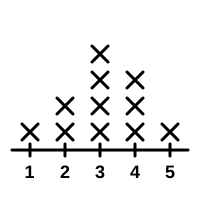
    Week 25 creates line plots from measurement data and answers data questions. In ELA, children learn collaborative-conversation rules and recount a well-elaborated event in writing.

    Parent tip

    Plot the family's shoe lengths on a giant paper line plot.

    Materials this week

    Ruler, graph paper, conversation cards

    Mathematics

    Line Plots and Measurement Data

    Data & Geometry · 2.MD.D.9

    Assessment: Create a line plot from measurement data; answer questions about the data

    ELA

    Collaborative Conversations: Rules and Roles

    Phonics: Review vowel teams

    Writing: Narrative

    Science

    Biodiversity & Interdependence

    2-LS2-1, 2-LS2-2, 2-LS4-1

    Social Studies

    Economics: Needs, Wants & Choices

    Monday — Day 121

    140 minutes of instruction

    Math

    Students will measure the lengths of household objects to the nearest inch and record the data in a table to prepare for a line plot (2.MD.D.9).

    Standards Addressed

    Activities

    10 min

    Warm-Up

    Spiral from Week 24: set out 3 quarters, 2 dimes, and 4 pennies and ask, 'How much money is this?' (99 cents). Then ask, 'What tool did we use last unit to measure length?' and have your child find the ruler.

    15 min

    Mini-Lesson

    Explain that today you are collecting data, which means information we gather to answer a question. Ask the question, 'How long are the spoons in our kitchen?' Model measuring one spoon to the nearest inch, saying 'The end is closest to the 6, so I record 6 inches.'

    15 min

    Practice

    Your child measures 10 spoons, forks, and knives from the drawer to the nearest inch and records each in a two-column table labeled Object and Length in inches. Check that each measurement starts at zero on the ruler.

    5 min

    Wrap-Up

    Ask, 'What was the shortest length you found? The longest? Did any lengths repeat?' Circle the repeated lengths in the table to set up tomorrow.

    Materials Needed

    ruler with inches10 spoons, forks, and knivespaperpencilcoins

    English Language Arts

    Students will agree on three conversation rules and use them to discuss how CJ's feelings change during the bus ride in 'Last Stop on Market Street' (SL.2.1a, RL.2.3).

    Standards Addressed

    Activities

    15 min

    Read-Aloud: Last Stop on Market Street

    Say: 'Last week we tracked how characters respond to what happens to them. Today watch CJ.' Read 'Last Stop on Market Street' by Matt de la Pena straight through, stopping three times: when CJ asks why they do not have a car, when he closes his eyes to listen to the guitar man, and on the last page. Each time ask, 'How does CJ feel right now, and which words tell you?'

    Last Stop on Market Street by Matt de la Pena
    10 min

    Mini-Lesson: Our Talking Together Rules

    On chart paper write 'Talking Together' and three rules: eyes on the speaker, one voice at a time, stay on the topic. Act out breaking each rule (interrupt, look at your phone, change the subject to lunch) and have your child catch you and name the rule you broke. Let your child add a fourth rule and sign the chart.

    chart paper or a large sheetmarker
    15 min

    Guided Reading: A Two-Person Conversation

    Reread the page where Nana tells CJ that when you are surrounded by dirt you are a better witness for what is beautiful. Hold a conversation using the rules on this question: 'What does Nana mean, and where in the book do we see it come true?' Each of you speaks at least twice, and your child puts a tally mark on a sticky note each time someone follows all three rules.

    Last Stop on Market Streetsticky notespencil
    15 min

    Writing Workshop: Choosing One Real Event

    Explain that this week and in Week 27 your child will write a recount, a true story about one event that really happened, like CJ's bus ride. Brainstorm a list of five real events (a bus or car ride, a visit to someone, a first time doing something, a day something went wrong) and star the one with the most to say. Your child tells the event aloud in one minute, then writes a first sentence that names who, where, and when.

    writing notebookpencil
    10 min

    Phonics: Vowel Teams ai and ay

    Write these twelve words on index cards: rain, paint, wait, train, chain, mail, play, stay, day, tray, gray, away. Your child reads each word, sorts into an 'ai' pile and an 'ay' pile, and notices that 'ai' sits in the middle of a word while 'ay' sits at the end. Your child writes three words from each pile in the notebook.

    index cardsmarkerwriting notebook

    Materials Needed

    Last Stop on Market Street by Matt de la Penachart paper or a large sheetmarkersticky noteswriting notebookpencilindex cards

    Science

    Students will observe and record the variety of living things in one small outdoor area and explain that biodiversity means 'many different kinds of life' (2-LS4-1).

    This week's reading: So Many Kinds of Living Things

    Standards Addressed

    Activities

    5 min

    Science Question of the Week

    Ask: 'How many different kinds of living things can we find in one square of our yard or park?' Remind your child that last week's Earth's Systems review was about where water and land are; this unit is about who lives there. Write the word 'biodiversity' on an index card and explain: bio means life, diversity means many different kinds.

    20 min

    Investigation: One-Square-Meter Survey

    Outside, lay four pieces of string or a hula hoop on the grass, a sidewalk edge, or a garden bed to mark one square. Kneel and hunt for 5 full minutes: grass, clover, dandelion, moss, ants, a beetle, a worm, a bird overhead, a spider web all count. Your child draws each different kind in a notebook and makes a tally mark each time it appears again. Support: you spot, your child draws. Stretch: your child sorts the finds into 'plant' and 'animal' columns and counts each column.

    string or hula hoopnotebookpencilmagnifying glass (optional)
    5 min

    Wrap-Up

    Count the number of different kinds found (most yards give 6 to 12). Say: 'That number is the biodiversity of our square. On Wednesday we will test a different square and see if the number changes.'

    Materials Needed

    string or hula hoopnotebookpencilindex cardmagnifying glass (optional)
    Open Monday on its own page
    Science

    Reading About Our World: So Many Kinds of Living Things

    Read it aloud first while your child follows along. Then read it together, and let your child read the parts they can. Talk about the words in the word box.

    Biodiversity means the many different kinds of living things in a place.

    Take a walk in a park. You might see oak trees, grass and dandelions. You might see robins, squirrels, ants and worms. That is a lot of different living things!

    Some places have more kinds of living things than others. Rain forests have more kinds of plants and animals than almost anywhere else on land. In warm oceans, coral reefs are home to many kinds of fish.

    Scientists find new kinds of living things every year. Many of them are tiny insects.

    Why does biodiversity matter? Living things depend on each other. Bees help plants make seeds. Plants give animals food and shelter. A place with many kinds of living things can stay healthy.

    How many different kinds of living things can you find in your yard or a park?

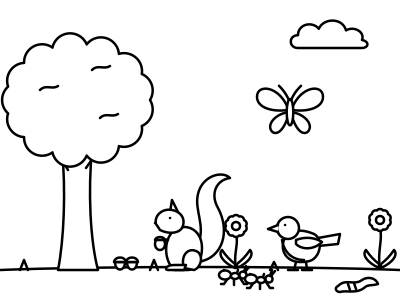
    A park full of different living things: an oak tree, a squirrel with an acorn, a robin, ants, a worm, dandelions and a butterfly.

    Word box

    biodiversity:
    the many different kinds of living things in a place
    rain forest:
    a warm place with tall trees that gets rain almost every day
    coral reef:
    a place in warm ocean water built by tiny animals called corals
    depend:
    to need something or someone

    Questions

    1. What does biodiversity mean?
    2. Which place on land has more kinds of plants and animals than almost anywhere else?
    3. Name one way living things depend on each other.

    Weekly check

    Math

    Weekly Check

    • I can measure objects and show the lengths on a line plot.
    • I can read a line plot and tell which length is most common.
    1. Ribbon lengths in inches: 2, 3, 3, 4, 3, 5, 4, 3, 2. Make a line plot with a title and a label.
    2. Which length is most common?
    3. How many ribbons are longer than 3 inches?
    4. How many ribbons in all?
    5. How many more ribbons are 3 inches than 5 inches?
    6. A shoe ends between 8 and 9. It is closer to 8. How long is it to the nearest inch?

    ELA

    Weekly Check

    • I can follow rules for a group talk: listen, take turns and stay on topic.
    • I can read and sort words with vowel teams.

    The Boat Trip

    On Sunday, Jay and his aunt rode a boat on the bay. The wind was cool. They each ate a peach and waved at a goat on the green hill.

    1. Tom keeps talking about his cat when the group is talking about the boat trip. Which rule did he break?eyes on the speakerone voice at a timestay on the topic
    2. What should you do while someone else is talking?
    3. Write two ai or ay words from the story.
    4. Write two ee or ea words from the story.
    5. Write two oa or ow words from the story.
    6. Sort: tail, meat, grow. Write the vowel team in each.

    Science

    Weekly Check

    • I can explain what biodiversity means.
    • I can compare how many kinds of living things live in different places.
    1. What does biodiversity mean?
    2. A garden has 11 kinds of living things. A parking lot has 3. Which place has more biodiversity?
    3. How many more kinds does the garden have?
    4. Why might the garden have more kinds of living things?
    5. Circle the place likely to have the most kinds of living things.a bare sidewalka pile of damp leavesa plastic slide

    Social Studies

    Weekly Check

    • I can tell the difference between a need and a want.
    • I can give examples of needs and wants.
    1. What is a need?
    2. What is a want?
    3. Circle the need.a video gamedrinking watera balloon
    4. Circle the want.a sweater in wintera housea toy truck
    5. Name two more needs.
    6. Name two more wants.

    Specials

    Art · Art from Around the World · All Specials

    This Week's Specials Page

    Art · Week 25

    I can make art with dots.

    Look: Dot painting

    1. Aboriginal artists in Australia have a long tradition of dot painting.
    2. Many dot paintings use rows and circles of dots.
    3. Dip a cotton swab in paint and press it straight down to make one dot.

    Make dot art inspired by this tradition. Use cotton swabs and paint, or the tip of a marker.

    1. Draw a simple animal outline. Fill it with rows of dots.
    2. Make a circle of dots around the edge of your animal.

    Think about it.

    1. How many colors did you use? ____
    2. How is making art with dots different from making art with lines?

    You need: cotton swabs, paint or markers, paper

    How did it go? Great Okay Tricky

    Home Connection

    This week at home

    • Math

      Measuring things and showing lengths on a line plot

    • ELA

      Talking together with rules and taking turns

    • Science

      Biodiversity means many different kinds of life

    • Social Studies

      Needs keep us alive; wants are nice extras

    Three things to celebrate this week

    We did blank of 4 activities.

    Suggested Daily Schedule

    8:30–9:00 AM30 minMorning Meeting / Calendar / Read-Aloud
    9:00–9:30 AM30 minPhonics / Word Study / Spelling
    9:30–10:15 AM45 minReading Workshop
    10:15–10:35 AM20 minSnack and Outdoor Play / Movement Break
    10:35–11:05 AM30 minWriting Workshop
    11:05–11:50 AM45 minMathematics
    11:50 AM–12:35 PM45 minLunch and Free Play
    12:35–1:05 PM30 minScience OR Social Studies (alternating)
    1:05–1:35 PM30 minSpecials: PE / Art / Music / Health (rotating)
    1:35–2:00 PM25 minIndependent Reading / Enrichment