Week 30: Unit 5 Review: Data and Geometry · Describing Story Structure (Review)

    Quarter 4 · Detailed day-by-day lesson plans · Days 146–150

    0 of 15 lessons done this week

    Unit 5 Review: Data and Geometry Describing Story Structure (Review)

    Print

    Worksheets and answer keys

    Unit test

    Gather this week

    • Shop
    • Shop
    • Shop
    • Shop
    Everyday supplies (11)

    Writing prompt

    • Write a story about an animal that can talk. What does it say to you?
    Week 30 writing prompts

    Parent note

    This week's parent digest

    Specials this week

    Unit 5 tests

    This week at a glance

    Week 30 reviews graphs, shapes, and equal shares in one mixed assessment. In ELA, readers describe story structure and complete a cumulative phonics review.

    Parent tip

    Make a one-page family newsletter with one bar graph and one drawn shape.

    Materials this week

    Mixed-review packet, family newsletter template

    Mathematics

    Unit 5 Review: Data and Geometry

    Data & Geometry · 2.MD.D.9

    Assessment: Mixed assessment: graphs, shapes, partitioning, and equal shares

    ELA

    Describing Story Structure (Review)

    Phonics: Cumulative phonics review

    Writing: Relationships between words

    Science

    Biodiversity & Interdependence

    2-LS2-1, 2-LS2-2, 2-LS4-1

    Social Studies

    Economics: Needs, Wants & Choices

    Monday — Day 146

    140 minutes of instruction

    Math

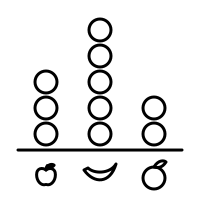
    Students will review line plots and bar graphs by collecting fresh household data and representing it both ways (2.MD.D.9, 2.MD.D.10).

    Standards Addressed

    Activities

    10 min

    Warm-Up

    Spiral from Week 29: fold a paper napkin into fourths and ask, 'How many fourths did I make? Show me two of the fourths.' Then ask, 'What kinds of graphs did we make this unit?'

    15 min

    Mini-Lesson

    Review the difference: line plots show measurements with Xs on a number line, bar graphs show categories with bars. Measure the lengths of 8 shoes by the door to the nearest inch and build the line plot together, then survey 'What color is each shoe?' and sketch a tally table.

    15 min

    Practice

    Your child builds a bar graph of the shoe colors on grid paper with a title and labels, then answers two questions from each graph: 'What is the most common shoe length? How many shoes are longer than 9 inches? Which color is most common? How many more of that color than the least common?'

    5 min

    Wrap-Up

    Ask, 'Why could the lengths go on a line plot but the colors could not?' Listen for 'lengths are numbers.'

    Materials Needed

    ruler with inches8 shoesgrid paperpaperpencilcrayons

    English Language Arts

    Students will describe the beginning, middle, and end of 'The Day the Crayons Quit' and order feeling words by strength (RL.2.5, L.2.5b).

    Standards Addressed

    Activities

    15 min

    Read-Aloud: The Day the Crayons Quit

    Say: 'Last week the pond book had a pattern. This week we look at the whole shape of a story.' Read 'The Day the Crayons Quit' by Drew Daywalt, and after the first three letters ask your child to guess what Duncan will do. Finish the book and name the three parts together: Duncan finds the letters, the crayons complain, Duncan draws a new picture.

    The Day the Crayons Quit by Drew Daywalt
    10 min

    Mini-Lesson: Story Structure Map

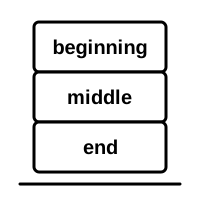
    Draw a map with three boxes: Beginning introduces the characters and setting, Middle grows the problem, Ending solves it. Fill it for the crayons book, then quickly fill it for 'Last Stop on Market Street' from Week 25 to show the same shape in a different story.

    chart papermarker
    15 min

    Guided Reading: Three Letters

    Your child picks three crayons and, for each, records the crayon, its problem, and what it wants on a chart. Then look at Duncan's final picture and find how each of the three complaints is answered, talking it through with stems.

    The Day the Crayons Quitpaperpencil
    15 min

    Writing Workshop: Shades of Feeling

    Write word cards for two sets: sad, upset, furious; and big, huge, enormous. Your child lines each set from weakest to strongest, acts each out, and writes which word fits red crayon (overworked) and which fits gray crayon (tired of huge animals), with a sentence for each.

    index cardsmarkerwriting notebookpencil
    10 min

    Phonics: Cumulative Review, Long Vowels

    Shuffle twelve cards mixing silent e and vowel teams: cake, bike, rope, cube, mule, stripe, rain, tray, feet, leaf, boat, snow. Sort by the long vowel sound heard (a, e, i, o, u), then read each pile. Write one silent e word and one vowel team word for the same sound.

    index cardswriting notebook

    Materials Needed

    The Day the Crayons Quit by Drew Daywaltchart papermarkerpaperpencilindex cardswriting notebook

    Science

    Students will test how different bird beak shapes work for different foods and explain that body features help animals survive in their habitats (2-LS4-1).

    Standards Addressed

    Activities

    5 min

    Science Question of the Week

    Point to the hawk on last week's mural. Ask: 'Why does a hawk have a hooked beak but a duck has a flat one?' Introduce the word adaptation: a body part or behavior that helps a living thing survive where it lives.

    20 min

    Investigation: Beak Buffet

    Set out four foods in bowls: dried beans (seeds), gummy worms or cooked spaghetti in a pan of water (worms in mud), rice in a cup of water (tiny pond food), and a raisin stuck in a straw (nectar deep in a flower). Provide four beaks: tweezers, a clothespin, a slotted spoon, and a drinking straw. Your child gets 20 seconds per beak per food and tallies how many pieces they collect. Support: you run the timer and record. Stretch: your child predicts the winner for each food before testing and checks the prediction.

    dried beansgummy worms or cooked spaghettiriceraisinstrawtweezersclothespinslotted spoon4 bowlstimernotebook
    5 min

    Wrap-Up

    Ask: 'Which beak was best for seeds? For scooping pond food?' Match each tool to a real bird: tweezers to a robin, clothespin to a cardinal, slotted spoon to a duck, straw to a hummingbird. Say: 'A bird with the wrong beak for its habitat would go hungry.'

    Materials Needed

    dried beansgummy worms or cooked spaghettiriceraisinstrawtweezersclothespinslotted spoon4 bowlstimernotebookpencil
    Open Monday on its own page
    Social Studies

    Reading About Our World: Let's Trade!

    Read it aloud first while your child follows along. Then read it together, and let your child read the parts they can. Talk about the words in the word box.

    Have you ever traded a snack with a friend? To trade means to give one thing and get another thing back.

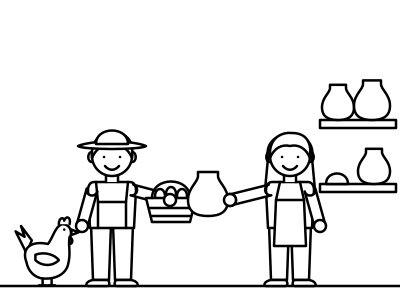
    Long ago, many people traded without money. A farmer with extra eggs might trade them for a pot that a potter made. Trading goods for goods is called barter.

    Barter can be hard. What if the potter does not want eggs? Then the farmer cannot get a pot. Money makes trading easier. The farmer can sell the eggs to anyone and use the money to buy a pot.

    Today, most trading uses money. When your family buys apples, you trade money for apples.

    Countries trade, too. Bananas grow best in hot, rainy places. Most bananas sold in the United States are grown in other countries, such as Guatemala and Ecuador. People in other countries buy goods from the United States, too. Trade helps people get things they cannot easily make or grow.

    A farmer offers a basket of eggs and a potter offers a clay pot, trading goods for goods.

    Word box

    trade:
    to give one thing and get another thing back
    barter:
    to trade goods or services without using money
    goods:
    things people make or grow to use or sell
    country:
    a land with its own people and government

    Questions

    1. What is barter?
    2. Why does money make trading easier?
    3. Why does the United States trade with other countries for bananas?

    Weekly check

    Math

    Weekly Check

    • I can read and make picture graphs, bar graphs and line plots.
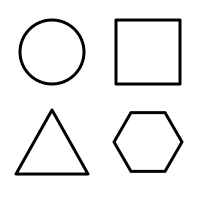
    • I can name shapes and split them into equal shares.
    1. A tally chart shows pets: dogs 4, cats 6, fish 2. How many more cats than fish?
    2. How many pets are there in all?
    3. In a picture graph, each star stands for 1 book. Kim has 5 stars. How many books did Kim read?
    4. Name a shape with 5 sides and 5 vertices.
    5. How many sides does a hexagon have?
    6. Draw a rectangle with 2 rows of 3 squares. Write the addition sentence.
    7. Draw a circle. Split it into fourths.

    ELA

    Weekly Check

    • I can tell the beginning, middle and end of a story, including the problem and how it is solved.
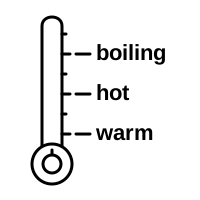
    • I can choose between words with shades of meaning (warm, hot, boiling).

    Max and the Mud

    Max wanted to play in the yard. But it rained all night, and the yard was muddy. Max put on his old boots. He splashed and stomped. Then Mom handed him a hose, and he washed his boots clean.

    1. Beginning: What did Max want?
    2. Middle: What was the problem?
    3. End: How was the problem solved?
    4. Order from weakest to strongest: downpour, drizzle, rain
    5. Which word is stronger?steppedstomped

    Science

    Weekly Check

    • I can explain how body parts and behaviors help animals survive.
    • I can give an example of an adaptation.
    1. What is an adaptation?
    2. A duck has webbed feet. How does this help it?
    3. A polar bear has thick fur and a layer of fat. How does this help it?
    4. A green grasshopper is hard to see in the grass. What is this adaptation called?
    5. Give your own example of an adaptation.

    Social Studies

    Weekly Check

    • I can explain what trade is and how money makes trading easier.
    • I can use this unit's words: needs, wants, goods, services, producers, consumers.
    1. What is trade?
    2. Why does money make trade easier?
    3. A haircut is a ____.goodservice
    4. Who is the producer: the farmer who grows apples or the boy who eats them?
    5. A coat in winter is a ____.needwant
    6. The boy who buys and eats the apples is a ____.producerconsumer

    Specials

    Music · Music from Around the World · All Specials

    This Week's Specials Page

    Music · Week 30

    I can compare instruments from different places.

    Look: Three instruments

    1. The djembe is a drum from West Africa. You play it with your hands.
    2. Maracas are shakers from Latin America. They are often made from gourds.
    3. Claves are two wooden sticks from Cuba. You tap them together.

    How do you play it? Circle one.

    1. djembehitshakeblow
    2. maracashitshakeblow
    3. claveshitshakeblow

    Make your own. Use a box for a drum, a shaker from Week 18 for maracas, and two wooden spoons for claves.

    1. Play a steady beat on each one. Which sound did you like best? Why?
    2. All three instruments are in the same family. Which one?stringswoodwindsbrasspercussion

    You need: a box, a homemade shaker, two wooden spoons

    How did it go? Great Okay Tricky

    Home Connection

    This week at home

    • Math

      Graphs, shapes and equal shares all together

    • ELA

      Every story has a beginning, middle and end

    • Science

      Body parts that help animals survive

    • Social Studies

      Trading helps us get what we need

    Three things to celebrate this week

    We did blank of 4 activities.

    Suggested Daily Schedule

    8:30–9:00 AM30 minMorning Meeting / Calendar / Read-Aloud
    9:00–9:30 AM30 minPhonics / Word Study / Spelling
    9:30–10:15 AM45 minReading Workshop
    10:15–10:35 AM20 minSnack and Outdoor Play / Movement Break
    10:35–11:05 AM30 minWriting Workshop
    11:05–11:50 AM45 minMathematics
    11:50 AM–12:35 PM45 minLunch and Free Play
    12:35–1:05 PM30 minScience OR Social Studies (alternating)
    1:05–1:35 PM30 minSpecials: PE / Art / Music / Health (rotating)
    1:35–2:00 PM25 minIndependent Reading / Enrichment