Week 31: Multi-Step Word Problems Across Domains · Literature Comprehension Review

    Quarter 4 · Detailed day-by-day lesson plans · Days 151–155

    0 of 15 lessons done this week

    Multi-Step Word Problems Across Domains Literature Comprehension Review

    Print

    Worksheets and answer keys

    Gather this week

    • Shop
    • Shop
    • Shop
    Everyday supplies (12)

    Writing prompt

    • Imagine a school on the moon. What's different about your day?
    Week 31 writing prompts

    Parent note

    This week's parent digest

    This week at a glance

    Week 31 begins the year-end review with two-step word problems across math domains. Readers review literature comprehension across genres and revisit decoding strategies.

    Parent tip

    Build a multi-step problem from a real shopping trip together.

    Materials this week

    Word-problem set, mixed-genre book stack

    Mathematics

    Multi-Step Word Problems Across Domains

    Review, Word Problems & Consolidation · All Grade 2 CCSS-M Standards

    Assessment: Solve 6 two-step word problems using multiple strategies

    ELA

    Literature Comprehension Review

    Phonics: All decoding strategies review

    Writing: Writing across genres review

    Science

    Review, Projects & Science Fair

    Review of all Grade 2 science standards; K-2-ETS1-1, K-2-ETS1-3 (science fair)

    Social Studies

    Review, Projects & Celebration

    Monday — Day 151

    140 minutes of instruction

    Math

    Students will solve two-step addition word problems by drawing a model and writing an equation with a symbol for the unknown (2.OA.A.1, 2.NBT.B.5).

    Standards Addressed

    Activities

    10 min

    Warm-Up

    Last week ended with equal shares, so start with a quick bridge: fold one paper into halves and one into fourths, then ask which piece is bigger. Then write 38 + 25 and 62 + 19 on the board and have your child solve both mentally, saying the strategy out loud (make a ten, add tens then ones).

    two sheets of paperwhiteboard or paper
    15 min

    Mini-Lesson

    Introduce Unit 6: 'For the next six weeks we are visiting every big idea from the year, and at the end you will plan a class picnic using all of it.' Review two-step addition problems (first taught Week 13): 'Maya had 27 stickers. She got 15 more on Monday and 8 more on Tuesday. How many now?' Model a bar model with three parts, write 27 + 15 + 8 = ?, and solve by adding 27 + 15 = 42, then 42 + 8 = 50.

    paperpencil
    15 min

    Practice

    Your child solves three problems with a bar model and an equation for each: 'A jar has 46 beans. Dad adds 23, then Grandma adds 9. How many beans?' (78). 'Leo read 18 pages, then 24 pages, then 12 pages. How many pages?' (54). 'A bus had 35 riders. 17 got on at the park and 6 got on at the library. How many riders?' (58). Check that the model matches the story before checking the answer.

    paperpencildried beans for modeling
    5 min

    Wrap-Up

    Start the Unit 6 math portfolio: label a folder 'My Grade 2 Math' and put today's best bar model inside. Ask: 'Which step did you do first, and how did you know?'

    foldertoday's work

    Materials Needed

    two sheets of paperwhiteboard or paperpencildried beansfolder

    English Language Arts

    Students will ask and answer who, what, where, when, why, and how questions about a story (RL.2.1, first taught in Week 1) and review long vowel teams while planning a narrative.

    Standards Addressed

    Activities

    15 min

    Read-Aloud

    Read 'A List' from Frog and Toad Together by Arnold Lobel. Before reading, say: 'Way back in Week 1 we learned that good readers ask questions. Keep one who, one what, and one why question in your head.' Stop after Toad's list blows away and have your child ask you one of the three questions out loud.

    Frog and Toad Together by Arnold Lobel
    10 min

    Mini-Lesson

    Write the six question words (who, what, where, when, why, how) on index cards and lay them in a row. Model answering 'Why can't Toad do anything after the list blows away?' by pointing to the exact page and reading the line that proves it. Say: 'An answer from the book beats an answer from my head.'

    index cardsmarker
    15 min

    Guided Reading

    Your child rereads 'A List' aloud, then draws one question card at a time and answers each with a finger on the page. Record answers on a 'Question and Answer' page in the reading notebook, in complete sentences.

    Frog and Toad Together by Arnold Lobelreading notebookpencil
    15 min

    Writing Workshop

    Genre review, day one: narrative (first taught in Week 3 and Week 25). Your child makes a list, just like Toad, of five things that happened yesterday, then circles the most interesting one to become this week's small-moment story. Have them write the first two sentences today, telling who was there and where it happened.

    10 min

    Phonics

    Vowel team review from Week 2 (ai, ay, ee, ea). Dictate: rain, stay, sleep, meal, wait, play, green, dream. Your child writes each, underlines the team, and reads the list back at speed.

    whiteboard or paperpencil

    Materials Needed

    Frog and Toad Together by Arnold Lobelindex cardsmarkerreading notebookpencilwhiteboard or paper

    Science

    Students will describe the stages of a plant life cycle and begin a sprouting investigation to observe the first stage firsthand (2-LS4-1, review of 2-LS2-1).

    This week's reading: From Egg to Frog

    Standards Addressed

    Activities

    5 min

    Science Question of the Week

    Ask: 'Last week we learned how animals are adapted to survive. What does a living thing need to do to keep its kind going?' Write the word 'life cycle' on an index card and say: every living thing is born, grows, makes new living things, and dies, and the circle starts again.

    20 min

    Investigation

    Fold a damp paper towel, tuck 4 dried beans (pinto or kidney from the pantry) inside, and slide it into a zip bag taped to a sunny window. Have your child draw the bag and beans on day 1 of a 'Bean Diary' page and write the date. Then lay out 4 index cards labeled seed, sprout, plant with flowers, plant with seed pods and have your child arrange them in a circle with arrows, explaining what happens at each arrow.

    4 dried beanspaper towelzip-top bagtapeindex cardscrayons
    5 min

    Wrap-Up

    Ask: 'Why do I draw the arrows in a circle instead of a straight line?' Listen for the idea that the last stage makes new seeds and the cycle repeats. Support: give the sentence frame 'The seed pods make new ____.' Stretch: ask what would happen to the cycle if bees never visited the flowers, linking back to pollination from Week 11.

    Materials Needed

    4 dried beanspaper towelzip-top bagtapeindex cardscrayonsnotebook
    Open Monday on its own page
    Science

    Reading About Our World: From Egg to Frog

    Read it aloud first while your child follows along. Then read it together, and let your child read the parts they can. Talk about the words in the word box.

    All living things have a life cycle. A life cycle is the way a living thing is born, grows and changes.

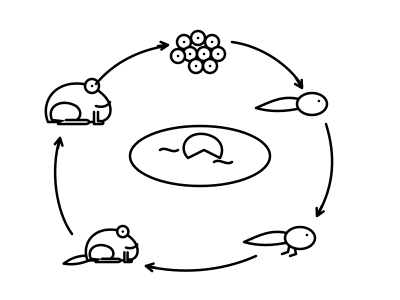
    Many frogs lay their eggs in a pond. The eggs are soft and jelly-like, and they often float together in a clump.

    A tadpole hatches from each egg. A tadpole lives in the water and has a long tail for swimming. It breathes with gills, like a fish.

    Slowly, the tadpole changes. It grows back legs. Then it grows front legs. Its tail gets shorter and shorter. Now it is a froglet, a young frog.

    The froglet grows into an adult frog. It can hop onto land and breathe air. One day, the adult frog lays eggs, and the life cycle starts again.

    A butterfly has a life cycle, too: egg, caterpillar, chrysalis, then butterfly. How are the two life cycles alike?

    The life cycle of a frog in a circle: eggs, a tadpole, a tadpole with back legs, a froglet with a short tail, and an adult frog.

    Word box

    life cycle:
    the way a living thing is born, grows and changes
    tadpole:
    a young frog that lives in water and has a tail
    gills:
    body parts that let an animal breathe under water
    adult:
    a living thing that is fully grown

    Questions

    1. Put in order: froglet, egg, adult frog, tadpole.
    2. How does a tadpole breathe?
    3. How does the tadpole's body change as it grows?

    Weekly check

    Math

    Weekly Check

    • I can solve word problems with more than one step.
    • I can write an equation for each step.
    1. Ivy had 26 shells. She found 18 more, then 9 more. How many shells now?
    2. A bakery made 72 rolls. It sold 34, then sold 19 more. How many are left?
    3. Jon has 45 stickers. Rae has 12 fewer. How many do they have together?
    4. A bus had 40 riders. 15 got off and 23 got on. How many riders now?
    5. A ribbon is 70 cm long. Ella cuts off 22 cm, then 30 cm. Write an equation for each step. How much is left?
    6. Nate has 1 quarter and 3 dimes. He spends 40 cents. How much is left?

    ELA

    Weekly Check

    • I can use more than one strategy to read a new word.
    • I can tell opinion, informational and narrative writing apart.
    1. What kind of writing is this? I think dogs are the best pets because they are loyal.opinioninformationalnarrative
    2. What kind of writing is this? Frogs lay eggs in water. The eggs hatch into tadpoles.opinioninformationalnarrative
    3. What kind of writing is this? Yesterday I found a tiny frog by the creek, and I held it.opinioninformationalnarrative
    4. Underline the vowel team: toast
    5. Circle the prefix, then read: unpaid
    6. Split into syllables: button
    7. Cover the suffix. What is the base word in thankful?

    Science

    Weekly Check

    • I can describe the life cycle of a frog or a butterfly.
    • I can put the stages of a life cycle in order.
    1. Put the butterfly stages in order: butterfly, egg, chrysalis, caterpillar.
    2. What hatches from a butterfly egg?
    3. What stage comes right before the butterfly?
    4. Where does a frog lay its eggs?
    5. What does a tadpole grow into?
    6. Why is a life cycle drawn as a circle?

    Social Studies

    Weekly Check

    • I can explain goods, services, producers and consumers.
    • I can give an example of each from my own community.
    1. A baker makes bread. Is the baker a producer or a consumer?producerconsumer
    2. A mail carrier brings letters. Is this a good or a service?goodservice
    3. When you buy apples at a store, you are a ____.
    4. Name a good you can buy in your community.
    5. Name a service in your community.
    6. Name a producer in your community.

    Specials

    PE · Fitness Testing & Field Day · All Specials

    This Week's Specials Page

    PE · Week 31

    I can measure my own personal best.

    Fitness check. Move in a clear, safe space with room to spread your arms. A grown-up keeps time. Rest and get a drink of water between each one. Try each one two times.

    ActivityTry 1Try 2
    1. Jumping jacks in 30 seconds
    2. Frog jumps in 30 seconds
    3. Sit and reach: sit with legs straight and reach for your toes. Circle how far you reached.kneesshinstoespast toes

    My personal best.

    1. Circle your higher number for each activity. Which try was better most of the time?Try 1Try 2
    2. A personal best means doing your best, not beating someone else. What is one thing you want to get better at?

    You need: a timer, water

    How did it go? Great Okay Tricky

    Home Connection

    This week at home

    • Math

      Solving word problems one step at a time

    • ELA

      Good readers ask and answer questions

    • Science

      Living things are born, grow and make more

    • Social Studies

      Goods, services, producers and consumers near me

    Three things to celebrate this week

    We did blank of 4 activities.

    Suggested Daily Schedule

    8:30–9:00 AM30 minMorning Meeting / Calendar / Read-Aloud
    9:00–9:30 AM30 minPhonics / Word Study / Spelling
    9:30–10:15 AM45 minReading Workshop
    10:15–10:35 AM20 minSnack and Outdoor Play / Movement Break
    10:35–11:05 AM30 minWriting Workshop
    11:05–11:50 AM45 minMathematics
    11:50 AM–12:35 PM45 minLunch and Free Play
    12:35–1:05 PM30 minScience OR Social Studies (alternating)
    1:05–1:35 PM30 minSpecials: PE / Art / Music / Health (rotating)
    1:35–2:00 PM25 minIndependent Reading / Enrichment