Week 36: Year-End Portfolio and Math Celebration · Reading and Writing Celebration

    Quarter 4 · Detailed day-by-day lesson plans · Days 176–180

    0 of 15 lessons done this week

    Year-End Portfolio and Math Celebration Reading and Writing Celebration

    Print

    Worksheets and answer keys

    Unit test

    Gather this week

    • Shop
    • Shop
    • Shop
    Everyday supplies (15)

    Writing prompt

    • What kind of friend do you want to be? Give examples.
    Writing prompts (from Week 35)

    Parent note

    This week's parent digest

    Unit 6 tests

    This week at a glance

    Week 36 celebrates the year with a portfolio performance task and an author celebration. Children share their best math thinking and writing pieces with family and peers.

    Parent tip

    Frame one writing piece and one math artifact to mark the year's growth.

    Materials this week

    Portfolio binder, frame, snacks for celebration

    Mathematics

    Year-End Portfolio and Math Celebration

    Review, Word Problems & Consolidation · All Grade 2 CCSS-M Standards

    Assessment: Year-end performance task: multi-domain assessment and portfolio

    ELA

    Reading and Writing Celebration

    Phonics: End-of-year celebration

    Writing: Author celebration and portfolio sharing

    Science

    Review, Projects & Science Fair

    Review of all Grade 2 science standards; K-2-ETS1-1, K-2-ETS1-3 (science fair)

    Social Studies

    Review, Projects & Celebration

    Monday — Day 176

    140 minutes of instruction

    Math

    Students will begin the 'Plan a class picnic' performance task by counting supplies to 1000 and adding three two-digit prices (2.NBT.A.1, 2.NBT.A.2, 2.NBT.B.6, 2.MD.C.8).

    Activities

    10 min

    Warm-Up

    Look back at last week's cake drawings and ask your child to explain fourths in one sentence. Then introduce the task: 'This week you are the picnic planner for a class of 24 kids. Every day you finish one part of the plan, and on Friday you present it.' Hand over a 'Picnic Planner' booklet made from four folded sheets.

    four sheets of paper folded into a bookletstapler or clipportfolio folder
    15 min

    Mini-Lesson

    Part 1, supplies (Week 5 skill): the supply closet has bundles. Set out beans as 3 groups of 100, 6 groups of 10, and 4 singles for cups (364). Your child records 364 in words and expanded form. Do the same for napkins: 5 hundreds, 0 tens, 8 ones (508). Ask: 'We need 400 cups. Do we have enough? How many more or fewer?' (36 fewer, 400 - 364).

    dried beans or strawsrubber bandsplanner bookletpencil
    15 min

    Practice

    Part 2, prices (Week 8 skill): choose three snacks from a price card (juice 28 cents, apple 35 cents, pretzels 19 cents, cookie 42 cents, cheese stick 26 cents). Your child adds the three prices two different ways (for example 28 + 35 + 19 = 82 cents) and records the equation and total in the booklet. Then pay the total with coins and check by counting them. Support: pick the three prices with ones digits that pair to ten. Stretch: find the most expensive and least expensive three-item combination and the difference between them.

    price cardcoinsplanner bookletpencil
    5 min

    Wrap-Up

    Ask: 'Which part felt like Week 5 and which felt like Week 8?' Clip the booklet into the portfolio folder.

    portfolio folder

    Materials Needed

    four sheets of paper folded into a bookletstapler or clipportfolio folderdried beans or strawsrubber bandspencilprice cardcoins

    English Language Arts

    Students will describe how a character responds to challenges over a long story (RL.2.3, first taught in Week 2) and begin assembling a reading and writing portfolio.

    Standards Addressed

    Activities

    15 min

    Read-Aloud

    Read the first two chapters of The Year of the Dog by Grace Lin, in which Pacy's family celebrates Chinese New Year and her mother says this is the year to find yourself. Ask: 'What does Pacy want to figure out this year? In Week 2 we learned to watch how a character handles a challenge. What is hers?'

    The Year of the Dog by Grace Lin
    10 min

    Mini-Lesson

    Say: 'This is our last week, and our last book is about a girl who discovers she wants to write and draw books. Sound familiar?' Start a 'Pacy's Tries' list on the whiteboard for things she tries during the year (add to it as you read this week), with a smiley or frown next to how each turns out.

    whiteboard or papermarker
    15 min

    Guided Reading

    Your child rereads the Chinese New Year chapter aloud and lists three things the family does to celebrate, then writes one sentence comparing it to a celebration in your own family.

    The Year of the Dog by Grace Linreading notebookpencil
    15 min

    Writing Workshop

    Portfolio day one. Give your child a folder or binder labeled 'My Second Grade Portfolio'. Together, choose five pieces from the Finished Pieces folder that show different genres (a story, an opinion, an informational piece, the collaborative story, a poem or letter) and put them in order from earliest to latest. Your child writes a sticky note on each: 'I learned to ____ from this piece.'

    folder or binderFinished Pieces foldersticky notespencil
    10 min

    Phonics

    Cumulative review game, day one: pattern bingo. Make a 3 by 3 grid with these patterns: ai, oa, silent e, ar, un-, -ful, two syllables, contraction, silent k. Call out words (rain, boat, bike, farm, unlock, hopeful, pencil, can't, knee) and your child covers the matching square and reads the word.

    paperpencildried beans for markers

    Materials Needed

    The Year of the Dog by Grace Linwhiteboard or papermarkerreading notebookpencilfolder or binderFinished Pieces foldersticky notespaperdried beans for markers

    Science

    Students will review the year's science units by sorting portfolio work into topics and choosing their best piece from each (2-PS1-1, 2-LS2-1, 2-LS4-1, 2-ESS2-1, K-2-ETS1-1).

    Standards Addressed

    Activities

    5 min

    Science Question of the Week

    Ask: 'Last week you were a science fair presenter. What did a scientist have to do this year before getting to present?' List the answers on a card: observe, ask, test, measure, graph, explain.

    20 min

    Investigation

    Spread the portfolio folder across the floor and set out 6 labeled papers: Matter, Plants and Animals, Engineering, Earth, Biodiversity, Science Fair. Your child sorts every piece onto the right pile, then picks one 'best' piece from each pile and says why: 'This one shows I can ____.' Stack the 6 best pieces in unit order.

    portfolio folder6 sheets of paper for labelsmarker
    5 min

    Wrap-Up

    Ask: 'Which unit had the most pieces? Which one do you wish we had spent more time on?' Write the answers on a sticky note for Friday.

    Materials Needed

    portfolio folder6 sheets of papermarkersticky note
    Open Monday on its own page
    Social Studies

    Reading About Our World: Reading a Map

    Read it aloud first while your child follows along. Then read it together, and let your child read the parts they can. Talk about the words in the word box.

    What Is a Map?

    A map is a drawing of a place as if you were looking down from above. A map can show a room, a town, a country or the whole world.

    Title and Key

    The title tells what the map shows. The map key explains the symbols. A symbol is a small picture that stands for something real. A tiny tree might stand for a park. A blue line might stand for a river.

    Which Way?

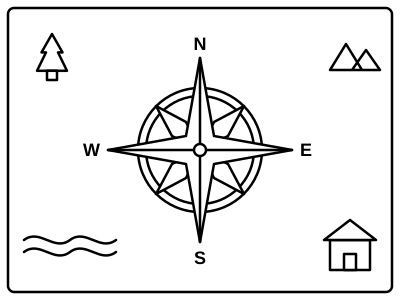
    The compass rose shows the directions: north, south, east and west. On most maps, north is at the top.

    Maps All Year

    This year you used maps of rooms, neighborhoods, states and the world. You found the seven continents and the five oceans. Maps help us find places, plan trips and learn about our world. Can you draw a map of your street?

    A compass rose shows north, south, east and west, with map symbols for a tree, mountains, a river and a house.

    Picture caption: A compass rose shows north, south, east and west.

    Word box

    map:
    a drawing of a place seen from above
    map key:
    the part of a map that tells what the symbols mean
    symbol:
    a small picture that stands for something real
    compass rose:
    a symbol that shows north, south, east and west

    Questions

    1. What does a map key tell you?
    2. Which heading would help you find out about directions?
    3. On most maps, which direction is at the top?

    Weekly check

    Math

    Weekly Check

    • I can solve word problems using what I learned this year.
    • I can show my thinking with a drawing, a bar model or an equation.
    1. Ava had 73 beads. She used 38. How many are left? Draw a bar model.
    2. A bus has 4 rows of 5 seats. 6 seats are empty. How many seats are full?
    3. Leo has 2 quarters and 3 dimes. He buys a juice for 65 cents. How much money is left?
    4. A ribbon is 45 inches. Another is 29 inches. How long are they together?
    5. Carmen read 125 pages in May and 148 pages in June. How many pages in all?
    6. 3 sandwiches are cut into halves. 4 halves are eaten. How many halves are left?
    7. Is 27 odd or even? Show why.

    ELA

    Weekly Check

    • I can choose my best work and tell why I am proud of it.
    • I can use the reading and writing skills I learned this year.

    Lucia's Poem

    Lucia wanted to read her poem at the school fair, but her voice shook. She practiced for her cat. She practiced for her grandpa. On the day of the fair, she took a deep breath and read every line. People clapped, and Lucia smiled wide.

    1. What was Lucia's problem?
    2. What did she do to solve it?
    3. What is the central message?
    4. Fix the sentence: lucia read her poem at the fair
    5. What does unhappy mean?
    6. Which piece in your portfolio are you proudest of? Tell why.

    Science

    Weekly Check

    • I can explain what I learned in science this year.
    • I can choose my best science work for my portfolio and tell why.
    1. What do plants need to grow?
    2. Heating can change matter. Give an example.
    3. What does an engineer do?
    4. Name one way wind or water can change land.
    5. What is a habitat?
    6. Choose your best science piece. Tell why.

    Social Studies

    Weekly Check

    • I can explain what I learned about communities, our country and the world.
    • I can choose my best work for my portfolio and tell why.
    1. What is a community?
    2. Which one is a landform?mountainmayormarket
    3. What is a tradition?
    4. Name an invention that changed how people live.
    5. Name a continent other than the one we live on.
    6. Choose your best social studies work. Tell why.

    Specials

    Health · Kindness, Community and Wellbeing Celebration · All Specials

    This Week's Specials Page

    Health · Week 36

    I can plan a balanced day and name habits I keep.

    Plan a balanced day. Draw or write one thing for each part.

    MoveReadScreen timeRest
    1. Which part of your day do you like best? Why?

    Habits I keep. Look back at this year's health pages.

    1. Circle the habits you keep.wash my handsdrink waterget good sleepcross the street safelybelly breathingbeing kind
    2. Draw yourself doing your favorite habit.
    3. Write one habit you want to keep working on next year.

    Challenge

    • Teach one habit to someone in your family. Who did you teach?
    How did it go? Great Okay Tricky

    Home Connection

    This week at home

    • Math

      Using all my math to plan a picnic

    • ELA

      Celebrating my best reading and writing this year

    • Science

      Sharing what I learned as a scientist

    • Social Studies

      Looking back at communities, maps and history

    Three things to celebrate this week

    We did blank of 4 activities.

    Suggested Daily Schedule

    8:30–9:00 AM30 minMorning Meeting / Calendar / Read-Aloud
    9:00–9:30 AM30 minPhonics / Word Study / Spelling
    9:30–10:15 AM45 minReading Workshop
    10:15–10:35 AM20 minSnack and Outdoor Play / Movement Break
    10:35–11:05 AM30 minWriting Workshop
    11:05–11:50 AM45 minMathematics
    11:50 AM–12:35 PM45 minLunch and Free Play
    12:35–1:05 PM30 minScience OR Social Studies (alternating)
    1:05–1:35 PM30 minSpecials: PE / Art / Music / Health (rotating)
    1:35–2:00 PM25 minIndependent Reading / Enrichment