Week 2: Hundreds Digit: Bundles of Tens · Describing Characters' Responses to Events

    Quarter 1 · Detailed day-by-day lesson plans · Days 6–10

    0 of 15 lessons done this week

    Hundreds Digit: Bundles of Tens Describing Characters' Responses to Events

    Print

    Worksheets and answer keys

    Gather this week

    • Shop
    • Shop
    • Shop
    Everyday supplies (15)

    Writing prompt

    • Write about a time you tried something new. What happened first, next, and last?
    Week 2 writing prompts

    Parent note

    This week's parent digest

    Specials this week

    Supplements

    This week at a glance

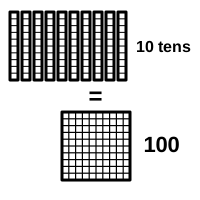
    Week 2 introduces the big idea that ten tens equal one hundred. In ELA, common vowel teams unlock longer words while children add feeling and action to narrative drafts.

    Parent tip

    Count groups of ten objects together until you hit one hundred.

    Materials this week

    Bundling sticks, vowel-team chart, narrative journal

    Mathematics

    Hundreds Digit: Bundles of Tens

    Place Value & Number Relationships · 2.NBT.A.1

    Assessment: Explain that 100 = 10 tens using drawings and place value charts

    ELA

    Describing Characters' Responses to Events

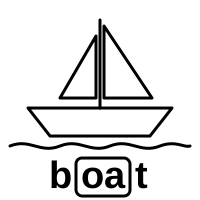
    Phonics: Common vowel teams for long vowels (ai, ay, ee, ea)

    Writing: Expand narratives with character actions and feelings

    Science

    Properties of Matter

    2-PS1-1, 2-PS1-2, 2-PS1-3, 2-PS1-4, K-2-ETS1-1

    Social Studies

    Rules, Laws & Community

    Monday — Day 6

    140 minutes of instruction

    Math

    Students will build and count bundles of ten to show that 100 is the same as 10 tens (2.NBT.A.1a).

    Standards Addressed

    Activities

    10 min

    Warm-Up

    Review last week's place value chart. Display 63 with beans and sticks: 6 bundles of ten and 3 loose beans. Ask, 'How many tens? How many ones? Now show me 36. What changed?'

    dried beanscraft sticks or strawsrubber bands
    15 min

    Mini-Lesson

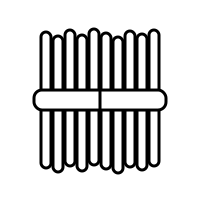
    Count out 100 craft sticks together by tens, bundling every 10 with a rubber band as you go. Line the 10 bundles up in a row and say, 'Ten bundles of ten. One hundred. 10 tens = 100.' Write 100 on an index card and place it above the bundles.

    100 craft sticks or strawsrubber bandsindex cardsmarker
    15 min

    Practice

    Student builds 40, 70, and 100 with bundles only, then draws each as a set of tall sticks and writes the matching sentence: '4 tens = 40', '7 tens = 70', '10 tens = 100'. Then ask for 9 tens and 1 more ten: what number is that?

    bundles of 10 craft stickspaperpencil
    5 min

    Wrap-Up

    Ask, 'If I have 10 bundles of ten, how many sticks is that? How do you know?' Student answers in a full sentence. Post the 100 card on the wall for the week.

    index card labeled 100

    Materials Needed

    dried beans100 craft sticks or strawsrubber bandsindex cardsmarkerpaperpencil

    English Language Arts

    Describe how Toad responds to the events in 'Spring' by naming what he does and how he feels (RL.2.3).

    Standards Addressed

    Activities

    15 min

    Read-Aloud

    Before reading, recall last week's Owl at Home: 'Remember how Owl kept running up and down the stairs to be upstairs and downstairs at once? Today we meet two new friends, Frog and Toad.' Read 'Spring' from Frog and Toad Are Friends by Arnold Lobel. Pause when Frog shouts up the stairs and again when Toad sees 'May' on the calendar, and ask, 'What does Toad do right here? How is he feeling?'

    Frog and Toad Are Friends by Arnold Lobel
    10 min

    Mini-Lesson

    Make a three-column chart titled Event, What the character does, How the character feels. Fill in one row together: Event: Frog wakes Toad in April. Does: pulls the covers over his head and says 'Blah.' Feels: sleepy and grumpy. Teach the big idea: authors show feelings through what characters do and say, so readers have to watch closely.

    Chart paper or a large sheet of paperMarkers
    15 min

    Guided Reading

    Your child rereads 'Spring' aloud (or reads a just-right book from the library basket). Give two sticky notes and ask them to mark one place where Toad does something because of an event, then tell you the event and the response in their own words.

    Frog and Toad Are Friends by Arnold LobelSticky notesLibrary books at your child's level
    15 min

    Writing Workshop

    Launch a two-week small-moment story. Brainstorm a list of moments with a friend or family member: a time you laughed hard, a time you were scared, a time something went wrong. Your child picks one, tells it across three fingers (first, next, last), and sketches the three parts in three boxes on a folded paper.

    Writing folderPaper folded into three boxesPencil and crayons
    10 min

    Phonics

    Introduce the vowel teams ai and ay, which both say long a. Write these words on index cards and read them together: rain, paint, train, wait, mail, snail, day, play, stay, away, gray, tray. Sort into two piles and ask what your child notices about where ai sits (middle) and where ay sits (end).

    Index cardsMarker

    Materials Needed

    Frog and Toad Are Friends by Arnold LobelChart paper or a large sheet of paperMarkersSticky notesLibrary books at your child's levelWriting folderPaper folded into three boxesPencil and crayonsIndex cards

    Science

    Students will observe, describe and sort household objects by properties such as color, texture, hardness, flexibility and whether they absorb water (2-PS1-1).

    Standards Addressed

    Activities

    5 min

    Science Question of the Week

    Ask, 'How can we describe what something is made of?' Remind your child that last week scientists used their senses to observe; this week the job is to use property words. Write the words color, texture, hardness, flexible and absorbs on an index card to keep on the table all week.

    20 min

    Investigation: Mystery Bag Properties

    Put 8 objects in a paper bag (a spoon, a sponge, a cotton ball, a rock, a rubber band, a paper clip, a wooden block, a crayon). Your child pulls one out without looking, describes it with at least three property words, then guesses what it is. Record each object and its properties in a chart with the columns Object, Color, Texture, Hard or Soft, Bends or Does Not Bend. Support: offer two choices for each column ('Is it rough or smooth?'). Stretch: add a column for 'What is it made of?' (metal, wood, plastic, cloth, stone).

    paper bag8 small household objectspaper and pencil
    5 min

    Wrap-Up

    Ask, 'Which two objects share the most properties? Which two are most different?' Have your child say one complete sentence such as 'The spoon and the paper clip are both hard and shiny.'

    Materials Needed

    paper bagspoonspongecotton ballrockrubber bandpaper clipwooden blockcrayonindex cardpaper and pencil
    Open Monday on its own page
    Social Studies

    Reading About Our World: Why Do We Have Laws?

    Read it aloud first while your child follows along. Then read it together, and let your child read the parts they can. Talk about the words in the word box.

    A rule tells us what to do or not do. At home, a rule might be "Put your toys away." At school, a rule might be "Raise your hand to speak."

    A law is a rule for everyone in a town, a state or a country. Laws are made by leaders the people choose.

    Laws help keep people safe. A speed limit tells drivers how fast they may go. A law says young children must ride in car seats. Laws also help things be fair. At a red light, drivers stop so people can take turns crossing.

    Some laws protect the places we share. In most towns it is against the law to litter. That keeps parks clean for everyone.

    When people break a law, there can be a consequence, like paying a fine. A consequence is what happens because of an action. Think about a rule you follow every day. Who does it help?

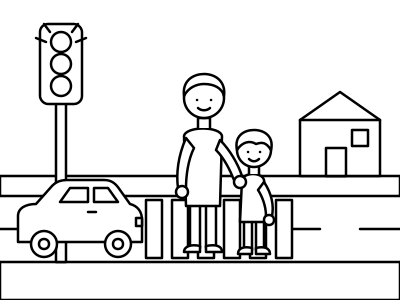
    At a red traffic light, a car waits while a grown-up and a child cross the street on the crosswalk.

    Word box

    rule:
    a guide for what to do at home, at school or in a game
    law:
    a rule that everyone in a town, state or country must follow
    fair:
    treating everyone the same way
    consequence:
    what happens because of an action

    Questions

    1. How is a law different from a rule?
    2. Name one law that keeps people safe.
    3. What is a consequence?

    Weekly check

    Math

    Weekly Check

    • I can explain that 10 tens make 100.
    • I can show a number as bundles of ten.
    1. How many tens make 100?
    2. Draw 5 tens. What number is it?
    3. Show 72 as bundles of ten and ones.
    4. 9 tens and 5 ones = ____
    5. Write 38 as tens and ones.
    6. Jo has 6 bundles of ten. How many more bundles does she need to make 100?

    ELA

    Weekly Check

    • I can tell how a character responds to what happens.
    • I can read words with ai, ay, ee and ea.

    Lee at the Beach

    Lee made a sand castle at the beach. Then a big wave came and washed it away. Lee felt upset. He sat on the sand. Then his friend May came to help. They made a new castle up high on the sand. Lee felt happy again.

    1. What happened to Lee's castle?
    2. How did Lee respond?
    3. What did May do?
    4. How did Lee feel at the end?
    5. Write the vowel team: faint
    6. Write the vowel team: stream
    7. Write the vowel team: tray

    Science

    Weekly Check

    • I can describe objects by their properties (color, shape, texture, hardness).
    • I can sort objects by one property.
    1. Which word tells about texture?bumpybluebig
    2. A rock is hard. A cotton ball is ____.
    3. Name two properties of a rubber band.
    4. Describe an apple with 3 property words.
    5. Sort by hard or soft: pillow, spoon, sock, coin.
    6. Sort by color: a banana, a lemon, a strawberry, a fire truck. Which go together?

    Social Studies

    Weekly Check

    • I can tell the difference between a rule and a law.
    • I can explain how a law keeps people safe.
    1. A rule is for a home or school. A law is for ____.
    2. Buckle your seat belt in the car.rulelaw
    3. Make your bed.rulelaw
    4. Do not litter in the park.rulelaw
    5. How does the crosswalk law keep people safe?
    6. What can happen if someone breaks a law?

    Specials

    Music · Steady Beat, Rhythm & Movement · All Specials

    This Week's Specials Page

    Music · Week 2

    I can keep a steady beat.

    Look: A steady beat

    1. A steady beat is like a clock. It stays even.
    2. Tap your knees: tap, tap, tap, tap.
    3. Keep each tap the same distance apart.

    Sing or hum "Yankee Doodle." Keep the beat in a new way each time. Move in a clear, safe space with room to spread your arms.

    1. Clap the beat. Did you stay steady? Circle one.yesalmostnot yet
    2. March the beat in place. Did you stay steady? Circle one.yesalmostnot yet
    3. Tap the beat on a pot or box. Did you stay steady? Circle one.yesalmostnot yet

    Echo clapping. A grown-up claps 4 beats. You clap it back.

    1. How many patterns did you echo just right? Make a tally mark for each one.
    2. Which way to keep the beat was easiest for you? Why?

    You need: a pot and spoon or an empty box

    How did it go? Great Okay Tricky

    Home Connection

    This week at home

    • Math

      Ten groups of ten make one hundred

    • ELA

      Characters show feelings by what they do

    • Science

      Properties help us pick the right material

    • Social Studies

      Laws are rules that keep communities safe

    Three things to celebrate this week

    We did blank of 4 activities.

    Suggested Daily Schedule

    8:30–9:00 AM30 minMorning Meeting / Calendar / Read-Aloud
    9:00–9:30 AM30 minPhonics / Word Study / Spelling
    9:30–10:15 AM45 minReading Workshop
    10:15–10:35 AM20 minSnack and Outdoor Play / Movement Break
    10:35–11:05 AM30 minWriting Workshop
    11:05–11:50 AM45 minMathematics
    11:50 AM–12:35 PM45 minLunch and Free Play
    12:35–1:05 PM30 minScience OR Social Studies (alternating)
    1:05–1:35 PM30 minSpecials: PE / Art / Music / Health (rotating)
    1:35–2:00 PM25 minIndependent Reading / Enrichment