Week 3: Hundreds Digit: Bundles of Hundreds · Story Structure: Beginning, Middle, End

    Quarter 1 · Detailed day-by-day lesson plans · Days 11–15

    0 of 15 lessons done this week

    Hundreds Digit: Bundles of Hundreds Story Structure: Beginning, Middle, End

    Print

    Worksheets and answer keys

    Gather this week

    • Shop
    • Shop
    • Shop
    • Shop
    Everyday supplies (10)

    Writing prompt

    • What is the best season of the year? Give three reasons.
    Week 3 writing prompts

    Parent note

    This week's parent digest

    Specials this week

    Supplements

    This week at a glance

    Week 3 builds hundreds with concrete models and explicit place-value reasoning. Readers practice story structure — beginning, middle, end — and writers sequence events in their drafts.

    Parent tip

    Retell a bedtime story together using your fingers for beginning, middle, end.

    Materials this week

    Hundreds chart, base-ten flats, story-map template

    Mathematics

    Hundreds Digit: Bundles of Hundreds

    Place Value & Number Relationships · 2.NBT.A.1

    Assessment: Show that the digits in each place represent amounts of hundreds, tens, and ones

    ELA

    Story Structure: Beginning, Middle, End

    Phonics: Vowel teams: oa, ow

    Writing: Write stories with a clear sequence of events

    Science

    Properties of Matter

    2-PS1-1, 2-PS1-2, 2-PS1-3, 2-PS1-4, K-2-ETS1-1

    Social Studies

    Rules, Laws & Community

    Monday — Day 11

    140 minutes of instruction

    Math

    Students will build numbers with hundreds, tens, and ones and name the value of each digit (2.NBT.A.1).

    Standards Addressed

    Activities

    10 min

    Warm-Up

    Last week we made one 100-bean bag. Today set out 2 bags and ask, 'How many beans? How many tens is that?' (200, 20 tens). Then 3 bags (300, 30 tens). Count by hundreds together up to 900.

    100-bean bags or paper flats
    15 min

    Mini-Lesson

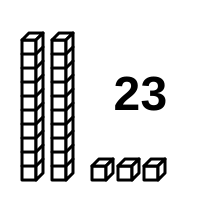
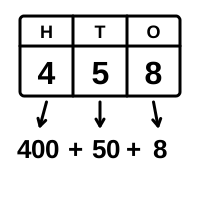
    Build 243 on a three-column Hundreds, Tens, Ones chart: 2 bags, 4 bundles, 3 beans. Say, 'The 2 is worth 200, the 4 is worth 40, the 3 is worth 3.' Write 243 = 200 + 40 + 3. Repeat with 316 and then 405, pointing out the empty tens column and the 0.

    100-bean bags or paper flatsbundles of 10 craft sticksdried beansplace value chartmarker
    15 min

    Practice

    Student builds 152, 378, 520, and 604 with bags, bundles, and beans, then writes each number on the chart and completes the sentence 'The ___ is worth ___' for every digit.

    100-bean bags or paper flatsbundles of 10 craft sticksdried beansplace value chartpencil
    5 min

    Wrap-Up

    Show 3 bags, 0 bundles, 7 beans. Ask, 'What number is this? Why can we not write 37?' Student explains that the zero holds the tens place.

    100-bean bags or paper flatsdried beans

    Materials Needed

    100-bean bags or paper flatsbundles of 10 craft sticksdried beansplace value chartmarkerpencil

    English Language Arts

    Identify the beginning, middle, and end of A Chair for My Mother and explain what each part does for the reader (RL.2.5).

    Standards Addressed

    Activities

    15 min

    Read-Aloud

    Say: 'Last week we watched how Toad felt about things. This week we look at how a whole story is built.' Read A Chair for My Mother by Vera B. Williams straight through. At the end ask, 'What did the family want, and did they get it?'

    A Chair for My Mother by Vera B. Williams
    10 min

    Mini-Lesson

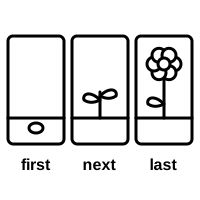
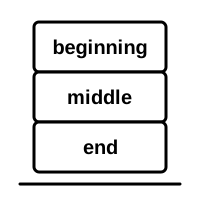
    Draw a three-part story map: Beginning introduces the characters, the place, and what they want; Middle tells what happens and what gets in the way; End tells how it works out. Fill in: Beginning: a girl, her mother, and grandma save coins in a big jar. Point out that the author jumps back to tell about the fire, and that this is still part of how the story is built.

    Chart paperMarkers
    15 min

    Guided Reading

    Your child reads a short just-right book (a Frog and Toad story works well) and uses three sticky notes labeled B, M, E to mark where each part starts. Have them explain each choice in one sentence.

    Library books at your child's levelSticky notes labeled B, M, E
    15 min

    Writing Workshop

    Reread last week's small-moment draft and lay it against the story map: does it have a clear beginning, middle, and end? Your child draws a box around each part and answers the Author's Chair question from Friday by adding one sentence where it belongs.

    Writing folderPencilCrayons
    10 min

    Phonics

    Introduce oa, which says long o. Read and write: boat, coat, road, soap, toast, goat, float, loaf, roast, throat. Your child underlines the oa in each and reads the list again quickly.

    Index cardsMarker

    Materials Needed

    A Chair for My Mother by Vera B. WilliamsChart paperMarkersLibrary books at your child's levelSticky notes labeled B, M, EWriting folderPencilCrayonsIndex cards

    Science

    Students will observe that heating causes some solids to melt and record how fast ice melts in different places (2-PS1-4).

    This week's reading: Hot and Cold Change Things

    Standards Addressed

    Activities

    5 min

    Science Question of the Week

    Ask, 'What happens to matter when it gets warm or cold?' Connect to last week: 'You described a rock as hard and a sponge as soft. Can heat change a property?' Write the words melt, freeze, solid and liquid on an index card for the table.

    20 min

    Investigation: Ice Cube Race

    Place one ice cube on each of four plates and put them in four spots: a sunny window, the kitchen counter, the refrigerator, and inside a folded towel. Your child predicts the order they will melt and writes 1 through 4 next to each spot. Check every 5 minutes and record whether each cube is 'still solid,' 'half melted,' or 'all liquid.' Support: check only the sunny window and the refrigerator. Stretch: use a kitchen timer and write the exact minute each cube finishes melting.

    4 ice cubes4 platestoweltimer or clockpaper and pencil
    5 min

    Wrap-Up

    Ask, 'Which spot won the melting race? What did that spot have that the others did not?' Guide your child to the word heat and the sentence 'Heat turned the solid ice into liquid water.'

    Materials Needed

    4 ice cubes4 platestoweltimer or clockindex cardpaper and pencil
    Open Monday on its own page
    Science

    Reading About Our World: Hot and Cold Change Things

    Read it aloud first while your child follows along. Then read it together, and let your child read the parts they can. Talk about the words in the word box.

    What happens to an ice cube on a warm day? It melts! Heat changes solid ice into liquid water.

    Cold can change things too. Put water in a freezer, and it turns back into solid ice. We can melt it and freeze it again and again.

    Heat changes many things. Butter melts in a warm pan. A crayon left in a hot car can melt and bend. Chocolate melts in your hand.

    Some changes cannot be undone. When you cook an egg, it turns from runny to firm. You cannot cool it and make it runny again. When you bake bread, the dough turns into bread. It cannot go back to dough.

    Next time you help cook, watch closely. What is changing? Can it change back?

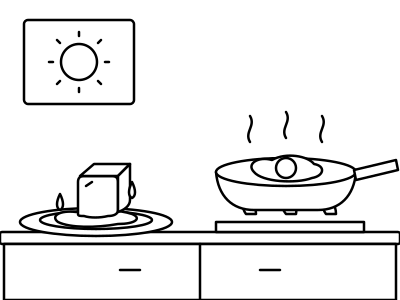
    An ice cube melts into a puddle on a plate while an egg cooks in a hot pan.

    Word box

    melt:
    to change from a solid to a liquid when heated
    freeze:
    to change from a liquid to a solid when cooled
    heat:
    warmth that can change things
    firm:
    solid and not runny

    Questions

    1. What makes ice melt?
    2. How can you turn water back into ice?
    3. Why can't a cooked egg become runny again?

    Weekly check

    Math

    Weekly Check

    • I can tell what each digit in a three-digit number is worth.
    • I can build numbers with hundreds, tens and ones.
    1. In 348, what is the 4 worth?
    2. In 912, what is the 9 worth?
    3. In 572, what is the 2 worth?
    4. Write the number: 6 hundreds, 3 tens, 0 ones
    5. Draw 415 with squares, sticks and dots.
    6. 7 hundreds, 0 tens and 8 ones = ____

    ELA

    Weekly Check

    • I can tell what happens at the beginning, middle and end of a story.
    • I can read words with oa and ow.

    The Slow Toad

    A toad sat by the road. He wanted to get to the pond, but he was slow. Then it began to snow! The toad hid in an old coat on the grass. When the snow was gone, the toad hopped on. At last, he got to the pond and swam.

    1. Beginning: What does the toad want?
    2. Middle: What gets in the way?
    3. What does the toad do about it?
    4. End: How does it work out?
    5. Write two words from the story with oa.
    6. Write one word from the story with ow.

    Science

    Weekly Check

    • I can explain how heating and cooling change materials.
    • I can tell what I observed during an investigation.
    1. What happens to ice when it is heated?
    2. What happens to water in the freezer?
    3. Heating can make a solid ____.meltfreeze
    4. Cooling can make a liquid ____.meltfreeze
    5. Where would ice melt faster?a sunny windowthe fridge
    6. Tell one thing you observed in an investigation this week.

    Social Studies

    Weekly Check

    • I can name community helpers and what they do.
    • I can explain how community helpers work together.
    1. What does a mail carrier do?
    2. Who puts out fires?
    3. Who helps sick people get well?
    4. Name a helper who keeps us safe.
    5. How do helpers work together when there is a fire?
    6. Which helper would you like to be? Why?

    Specials

    PE · Locomotor Skills & Body Awareness · All Specials

    This Week's Specials Page

    PE · Week 3

    I can move in different ways with control.

    Animal walks. Move in a clear, safe space with room to spread your arms. Do each walk across the space and back. Put a check when you finish.

    1. Bear crawl: hands and feet on the floor, hips up.
    2. Crab walk: tummy up, walk on hands and feet.
    3. Frog jumps: squat low, then jump forward.
    4. Inchworm: walk your hands out, then walk your feet in.

    Think about it.

    1. Which walk was hardest? Circle one.bearcrabfroginchworm
    2. Draw yourself doing your favorite animal walk.

    You need: a clear open space, sneakers or bare feet on a non-slip floor

    How did it go? Great Okay Tricky

    Home Connection

    This week at home

    • Math

      A digit is worth more in a bigger place

    • ELA

      Stories have a beginning, a middle and an end

    • Science

      Heating and cooling can change solids and liquids

    • Social Studies

      Community helpers do jobs that help everyone

    Three things to celebrate this week

    We did blank of 4 activities.

    Suggested Daily Schedule

    8:30–9:00 AM30 minMorning Meeting / Calendar / Read-Aloud
    9:00–9:30 AM30 minPhonics / Word Study / Spelling
    9:30–10:15 AM45 minReading Workshop
    10:15–10:35 AM20 minSnack and Outdoor Play / Movement Break
    10:35–11:05 AM30 minWriting Workshop
    11:05–11:50 AM45 minMathematics
    11:50 AM–12:35 PM45 minLunch and Free Play
    12:35–1:05 PM30 minScience OR Social Studies (alternating)
    1:05–1:35 PM30 minSpecials: PE / Art / Music / Health (rotating)
    1:35–2:00 PM25 minIndependent Reading / Enrichment