Week 6: Comparing Three-Digit Numbers · Point of View: Different Characters

    Quarter 1 · Detailed day-by-day lesson plans · Days 26–30

    0 of 15 lessons done this week

    Comparing Three-Digit Numbers Point of View: Different Characters

    Print

    Worksheets and answer keys

    Unit test

    Gather this week

    • Shop
    • Shop
    • Shop
    Everyday supplies (17)

    Writing prompt

    • Pick an animal you know about. Describe what it eats, where it lives, and one cool fact.
    Week 6 writing prompts

    Parent note

    This week's parent digest

    Specials this week

    Supplements

    Unit 1 tests

    This week at a glance

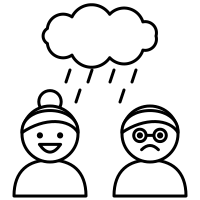
    Week 6 compares three-digit numbers using place-value reasoning and the >, =, < symbols. In reading, children notice how two characters can have different points of view.

    Parent tip

    Play 'which is greater?' with three-digit numbers from house numbers, book pages, or receipts.

    Materials this week

    Number cards, comparison symbols, two-character read-aloud

    Mathematics

    Comparing Three-Digit Numbers

    Place Value & Number Relationships · 2.NBT.A.1

    Assessment: Compare pairs of three-digit numbers using >, =, < with place value reasoning

    ELA

    Point of View: Different Characters

    Phonics: Reading with accuracy and fluency

    Writing: Compare two characters' points of view in writing

    Science

    Properties of Matter

    2-PS1-1, 2-PS1-2, 2-PS1-3, 2-PS1-4, K-2-ETS1-1

    Social Studies

    Rules, Laws & Community

    Monday — Day 26

    140 minutes of instruction

    Math

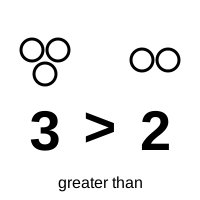
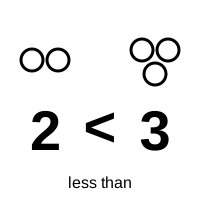
    Students will compare two three-digit numbers by looking at the hundreds digit first and use the symbols >, <, and = (2.NBT.A.4).

    Standards Addressed

    Activities

    10 min

    Warm-Up

    Write 358 on the board from last week's forms. Student writes it in expanded form (300 + 50 + 8). Then ask, 'Which is bigger, 358 or 400? How do you know without counting?'

    papermarker
    15 min

    Mini-Lesson

    Build 245 and 512 side by side with bags, bundles, and beans. Ask, 'Which pile has more hundreds?' Introduce the symbols: write 245 < 512 and read it 'two hundred forty-five is less than five hundred twelve.' Explain that the open side faces the bigger number, like a hungry mouth. Repeat with 630 and 470 (630 > 470) and with 318 and 318 (=).

    100-bean bags or paper flatsbundles of 10 craft sticksdried beanspapermarker
    15 min

    Practice

    Student builds and compares 6 pairs, writing the symbol each time: 421 and 397, 150 and 610, 805 and 805, 299 and 301, 760 and 670, 500 and 499. For each, student says which digit decided it.

    100-bean bags or paper flatsbundles of 10 craft sticksdried beanspaperpencil
    5 min

    Wrap-Up

    Ask, 'Why is 301 bigger than 299 even though 299 has bigger digits?' Student explains that the hundreds digit matters most.

    Materials Needed

    papermarker100-bean bags or paper flatsbundles of 10 craft sticksdried beanspencil

    English Language Arts

    Identify who is telling The Three Little Pigs and describe the pigs' point of view about the wolf (RL.2.6).

    Standards Addressed

    Activities

    15 min

    Read-Aloud

    Say: 'Last week we read pictures closely. This week we ask who is telling the story, because that changes everything.' Read The Three Little Pigs (James Marshall's version or another traditional retelling). Ask after each house: 'What does the wolf say? What does the pig say? Who do we feel sorry for?'

    The Three Little Pigs (traditional version, such as James Marshall's)
    10 min

    Mini-Lesson

    Teach point of view: the person telling the story chooses what we see. Start a T-chart labeled The pigs' side / The wolf's side. Fill in the pigs' side: the wolf is big and bad, he wants to eat us, we are smart to build with bricks.

    Chart paperMarkers
    15 min

    Guided Reading

    Your child rereads the wolf's and pigs' lines from the brick-house scene in two different voices: a deep growly wolf and a squeaky pig. Then ask, 'How does the pig feel about the wolf? What words show it?'

    The Three Little Pigs (traditional version, such as James Marshall's)
    15 min

    Writing Workshop

    Plan a two-character point of view piece about one event: the wolf arrives at the brick house. Fold a paper in half, label one side Pig and one side Wolf, and jot what each character sees, wants, and feels in that moment.

    Writing folderPaper folded in halfPencil
    10 min

    Phonics

    Fluency warm-up with a cumulative vowel-team review. Read this list three times, each time faster and smoother: rain, sleep, boat, snow, play, leaf, coat, tree, mail, glow, beach, yellow. Time the third read and celebrate the improvement.

    Index cardsMarkerA timer or phone

    Materials Needed

    The Three Little Pigs (traditional version, such as James Marshall's)Chart paperMarkersWriting folderPaper folded in halfPencilIndex cardsA timer or phone

    Science

    Students will show that a set of small pieces can be taken apart and built into a new object and review how properties describe matter (2-PS1-3, 2-PS1-1).

    Standards Addressed

    Activities

    5 min

    Science Question of the Week

    Ask, 'Can the same pieces make different things?' Remind your child that last week they picked materials for a job. Show a small pile of 20 building blocks (LEGO, wooden blocks or interlocking cubes) and ask, 'How many different things could these become?' Write the words pieces, take apart and build on an index card.

    20 min

    Investigation: Same Pieces, New Object

    Give your child exactly 20 blocks. Build a tower, count the blocks, and draw it. Take it fully apart and build a bridge with the same 20 blocks, then a house, then an animal, drawing and counting each time. Ask after each, 'Did we add any pieces? Did we lose any?' Support: build two objects and count together. Stretch: build one object that uses every block flat on the table and one that stands tall, then compare which is sturdier.

    20 building blocks or interlocking cubespaper and pencil
    5 min

    Wrap-Up

    Ask, 'What stayed the same each time? What changed?' Guide your child to the sentence 'The pieces stayed the same, but the object changed.'

    Materials Needed

    20 building blocks or interlocking cubesindex cardpaper and pencil
    Open Monday on its own page
    Social Studies

    Reading About Our World: Rights and Responsibilities

    Read it aloud first while your child follows along. Then read it together, and let your child read the parts they can. Talk about the words in the word box.

    In our country, people have rights. A right is something every person should be free to do or have. You have the right to be safe. You have the right to go to school and learn. People have the right to share their ideas.

    Rights come with responsibilities. A responsibility is something you should do. If you have the right to learn, you have the responsibility to listen and try your best. If you have the right to be safe, you have the responsibility to help keep others safe too.

    At home you have rights and responsibilities. You have the right to a safe place to sleep. You have the responsibility to help keep your home tidy.

    When everyone takes care of their responsibilities, everyone's rights are protected. What is one right you have? What responsibility goes with it?

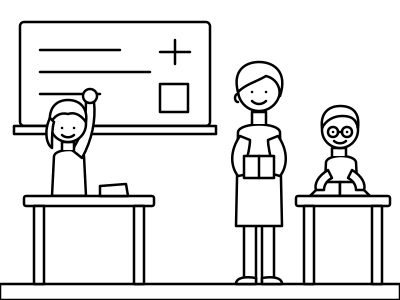
    In a classroom, a teacher reads to the class while one child raises a hand and another listens with a book.

    Word box

    right:
    something every person should be free to do or have
    responsibility:
    something you should do
    protect:
    to keep safe
    share:
    to tell or give something to others

    Questions

    1. What is a right?
    2. What responsibility goes with the right to learn?
    3. What happens when everyone takes care of their responsibilities?

    Weekly check

    Math

    Weekly Check

    • I can compare three-digit numbers using >, = and <.
    • I can explain my comparison using hundreds, tens and ones.
    1. 471 ____ 417><=
    2. 286 ____ 628><=
    3. 539 ____ 539><=
    4. 798 ____ 800><=
    5. Order from least to greatest: 362, 236, 623, 326
    6. Explain how you know 845 > 841.

    ELA

    Weekly Check

    • I can tell how two characters see things differently.
    • I can read smoothly and fix my mistakes.

    The Last Cake

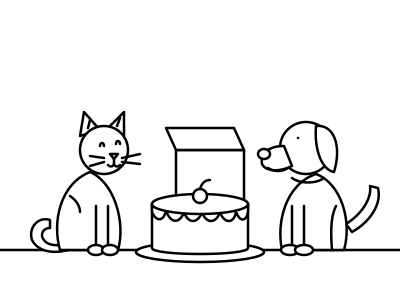
    Cat: That cake is mine. I saw it first! Dog: But I was the one who found the box. I think we should share it.

    A cat and a dog sit on each side of one cake.
    1. What does the cat think?
    2. What does the dog think?
    3. How are their points of view different?
    4. Read the text aloud two times. Grown-up: did the reader go back and fix a mistake?yesno mistakesnot yet
    5. Grown-up: was the reading smooth?smoothgetting there

    Science

    Weekly Check

    • I can describe and classify matter by its properties.
    • I can explain how heating and cooling change things.
    1. Circle the thing that is soft.a rocka cotton balla spoon
    2. Circle the thing that bends.a rubber banda bricka glass cup
    3. What happens to ice when it is heated?
    4. What happens to water in the freezer?
    5. Melted chocolate cools. Can it get hard again?yesno
    6. An egg is cooked. Can it change back?yesno

    Social Studies

    Weekly Check

    • I can explain how rules, laws and good citizens help a community.
    • I can use this unit's words correctly.
    1. A law is ____.a rule that everyone in a community must followa kind of game
    2. Name one community helper and what they do.
    3. Why do communities need rules?
    4. Which one shows a good citizen?picking up trash at the parkcutting in line
    5. Use the word citizen in a sentence.

    Specials

    Music · Steady Beat, Rhythm & Movement · All Specials

    This Week's Specials Page

    Music · Week 6

    I can move to fast and slow, loud and soft music.

    Look: Music words

    1. Tempo is how fast or slow music goes.
    2. Dynamics is how loud or soft music is.

    A grown-up sings or plays "Row, Row, Row Your Boat" in different ways. Move in a clear, safe space with room to spread your arms. Circle how the music sounds and move to match it.

    1. Time 1: Walk in place to the music. The tempo is ____fastslow
    2. Time 2: Tiptoe or stomp to the music. The dynamics are ____loudsoft
    3. Time 3: Move your own way. The music is ____ and ____

    Your turn to lead.

    1. Pick a tempo and dynamics. Clap "Row, Row, Row Your Boat" that way for a grown-up. Write what you chose.
    2. How does slow, soft music make you want to move?
    How did it go? Great Okay Tricky

    Home Connection

    This week at home

    • Math

      Compare numbers by checking hundreds, then tens, then ones

    • ELA

      Two characters can see one thing differently

    • Science

      Small pieces can build many new things

    • Social Studies

      Rules, helpers and citizens make communities work

    Three things to celebrate this week

    We did blank of 4 activities.

    Suggested Daily Schedule

    8:30–9:00 AM30 minMorning Meeting / Calendar / Read-Aloud
    9:00–9:30 AM30 minPhonics / Word Study / Spelling
    9:30–10:15 AM45 minReading Workshop
    10:15–10:35 AM20 minSnack and Outdoor Play / Movement Break
    10:35–11:05 AM30 minWriting Workshop
    11:05–11:50 AM45 minMathematics
    11:50 AM–12:35 PM45 minLunch and Free Play
    12:35–1:05 PM30 minScience OR Social Studies (alternating)
    1:05–1:35 PM30 minSpecials: PE / Art / Music / Health (rotating)
    1:35–2:00 PM25 minIndependent Reading / Enrichment