Week 4: Skip-Counting by 5s, 10s, and 100s · Retelling and Determining Central Message

    Quarter 1 · Detailed day-by-day lesson plans · Days 16–20

    0 of 15 lessons done this week

    Skip-Counting by 5s, 10s, and 100s Retelling and Determining Central Message

    Print

    Worksheets and answer keys

    Gather this week

    • Shop
    • Shop
    • Shop
    • Shop
    Everyday supplies (16)

    Writing prompt

    • If you could invent a new ice cream flavor, what would it be and what's in it?
    Week 4 writing prompts

    Parent note

    This week's parent digest

    Specials this week

    Supplements

    This week at a glance

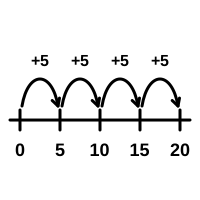
    Skip counting by 5s, 10s, and 100s reveals patterns on the number chart. In ELA, children determine the central message of a story and launch opinion writing with reasons.

    Parent tip

    Skip count out loud while climbing stairs or jumping on a trampoline.

    Materials this week

    Hundreds chart, sticky notes, favorite picture book

    Mathematics

    Skip-Counting by 5s, 10s, and 100s

    Place Value & Number Relationships · 2.NBT.A.1

    Assessment: Skip count from any starting number; identify patterns on the number chart

    ELA

    Retelling and Determining Central Message

    Phonics: Long vowels with silent e review

    Writing: Opinion writing introduction

    Science

    Properties of Matter

    2-PS1-1, 2-PS1-2, 2-PS1-3, 2-PS1-4, K-2-ETS1-1

    Social Studies

    Rules, Laws & Community

    Monday — Day 16

    140 minutes of instruction

    Math

    Students will skip-count by 5s and 10s within 1000 and describe the pattern in the ones digit (2.NBT.A.2).

    Standards Addressed

    Activities

    10 min

    Warm-Up

    Show 3 bags, 4 bundles, 5 beans from last week (345). Then add one bundle at a time and count aloud: 355, 365, 375, 385, 395. Ask, 'What changes each time? What stays the same?'

    100-bean bags or paper flatsbundles of 10 craft sticksdried beans
    15 min

    Mini-Lesson

    On the hundreds chart, color every number you land on counting by 5s from 5 to 100. Ask what the ones digits do (5, 0, 5, 0). Then use a different color to circle counting by 10s from 10 to 100 and notice that every 10 is also a 5. Count by 5s aloud from 100 to 150 without the chart.

    printed hundreds charttwo crayons
    15 min

    Practice

    Student writes the next 6 numbers for each start: by 5s from 35 (40, 45, 50, 55, 60, 65), by 5s from 210, by 10s from 60, by 10s from 430. Then uses nickels to count by 5s to 50 cents and dimes to count by 10s to 100 cents.

    paperpencil10 nickels10 dimes
    5 min

    Wrap-Up

    Ask, 'If you count by 5s, will you ever say 43? Will you ever say 195? How do you know without counting?'

    Materials Needed

    100-bean bags or paper flatsbundles of 10 craft sticksdried beansprinted hundreds charttwo crayonspaperpencil10 nickels10 dimes

    English Language Arts

    Retell Chrysanthemum using a five-finger retell and begin to think about the central message (RL.2.2).

    Standards Addressed

    Activities

    15 min

    Read-Aloud

    Say: 'Last week we mapped beginnings, middles, and ends. This week we ask what a story is really about.' Read Chrysanthemum by Kevin Henkes. Stop when Chrysanthemum wilts after the first day of school and ask what happened to make her feel that way.

    Chrysanthemum by Kevin Henkes
    10 min

    Mini-Lesson

    Trace your child's hand and label the fingers: characters, setting, beginning, middle, end, with 'lesson' on the palm. Fill in the fingers together for Chrysanthemum (Chrysanthemum, her parents, Victoria, Mrs. Twinkle; home and school). Leave the palm blank and say we will earn it by the end of the week.

    PaperPencilMarkers
    15 min

    Guided Reading

    Your child rereads the first half of Chrysanthemum (or a just-right book) and retells it to you across the five fingers. Prompt with 'Who? Where? What happened first?' as needed.

    Chrysanthemum by Kevin HenkesLibrary books at your child's levelHand-trace retell sheet
    15 min

    Writing Workshop

    Introduce opinion writing: an opinion is what you think, and a reason tells why. Sort cards together: 'Dogs are the best pets' (opinion), 'Dogs have four legs' (fact), 'Winter is the best season' (opinion), 'Snow is cold' (fact). Announce this week's piece: 'Chrysanthemum is a perfect name' or 'Chrysanthemum is not a perfect name.'

    Index cards with four sentencesWriting folder
    10 min

    Phonics

    Review silent e with a_e and i_e. Read and write: cake, made, plane, gate, shape, bike, ride, smile, kite, white. Show the magic: cap to cape, kit to kite, and have your child do the same with mad and pin.

    Index cardsMarkerWhiteboard or paper

    Materials Needed

    Chrysanthemum by Kevin HenkesPaperPencilMarkersLibrary books at your child's levelHand-trace retell sheetIndex cards with four sentencesWriting folderIndex cardsWhiteboard or paper

    Science

    Students will sort changes to matter into those that can be reversed and those that cannot (2-PS1-4).

    Standards Addressed

    Activities

    5 min

    Science Question of the Week

    Ask, 'Can every change be undone?' Remind your child that last week ice melted and froze again. Then hold up a piece of toast next to a slice of bread and ask, 'Can I turn this toast back into bread?' Write the words reversible and irreversible on an index card.

    20 min

    Investigation: Can We Undo It?

    Set up five stations: (1) melt an ice cube in a bowl, (2) crumple a sheet of paper, (3) cut a sheet of paper in half, (4) stir a spoon of sugar into warm water, (5) mash a banana slice. For each, your child makes the change, then tries to undo it, and records 'reversible' or 'irreversible' with a reason in a chart. Support: do stations 1, 2 and 3 only. Stretch: predict before testing and mark each prediction right or wrong.

    ice cubebowl2 sheets of paperscissorssugarwarm waterspoonbanana slicepaper and pencil
    5 min

    Wrap-Up

    Ask, 'Which changes could go back? Which changes made something brand new?' Have your child explain why the crumpled paper is reversible even though it looks different (it is still paper) but the cut paper is not.

    Materials Needed

    ice cubebowl2 sheets of paperscissorssugarwarm waterspoonbanana slicetoast and bread sliceindex cardpaper and pencil
    Open Monday on its own page
    Social Studies

    Reading About Our World: What Makes a Good Citizen?

    Read it aloud first while your child follows along. Then read it together, and let your child read the parts they can. Talk about the words in the word box.

    A citizen is a member of a community. Your community might be your family, your class, your town or your country.

    Good citizens help make their community a better place. They follow rules and laws. They tell the truth. They are kind and fair to others.

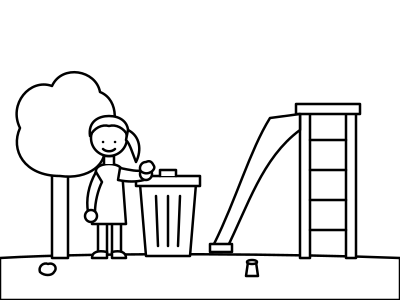
    Good citizens also help. A girl picks up litter at the playground. A boy holds the door for a neighbor. A family gives food to people who need it. Grown-ups can vote to choose leaders.

    Good citizens are responsible. Being responsible means doing your jobs without being asked, like feeding your pet or cleaning up after a snack.

    Good citizens listen to others, even when they do not agree. They solve problems by talking, not fighting. What is one thing you can do this week to be a good citizen?

    A girl picks up litter at the playground and puts it in a trash can.

    Word box

    citizen:
    a member of a community or country
    community:
    a group of people who live, learn or work together
    responsible:
    doing your jobs without being asked
    vote:
    to make a choice that is counted with other people's choices

    Questions

    1. What is a citizen?
    2. Name two things good citizens do.
    3. What does it mean to be responsible?

    Weekly check

    Math

    Weekly Check

    • I can skip-count by 5s, 10s and 100s from any number.
    • I can find patterns on a number chart.
    1. Count by 5s: 340, 345, ____, ____, ____
    2. Count by 10s: 176, 186, ____, ____, ____
    3. Count by 100s: 58, 158, ____, ____, ____
    4. Fill in: 710, 720, ____, 740, ____
    5. Count by 5s: 890, 895, ____, ____
    6. On a hundreds chart, what number is one row below 57?
    7. Count by 10s from 3. What do the ones digits do?

    ELA

    Weekly Check

    • I can retell a story and tell its central message.
    • I can read words with silent e and with ar, or, er, ir and ur.

    The Crow's Stone

    A crow had a pretty stone. "This is mine!" she said. A little bird asked to see it. The crow said no and hid it. Then a storm came, and the crow's nest fell. The little bird let the crow stay in her nest. The next day, the crow gave the little bird the pretty stone.

    1. Who are the characters?
    2. What happened first?
    3. What problem came in the middle?
    4. How did it end?
    5. What is the central message?
    6. Write two words from the story with silent e.
    7. Write the word with ir and the word with or.

    Science

    Weekly Check

    • I can tell which changes can be undone and which cannot.
    • I can give an example of each.
    1. Melting an ice popreversibleirreversible
    2. Baking cookie dough into cookiesreversibleirreversible
    3. Folding a towelreversibleirreversible
    4. Freezing juicereversibleirreversible
    5. Give one example of a change that can be undone.
    6. Give one example of a change that cannot be undone.
    7. How can you tell a change cannot be undone?

    Social Studies

    Weekly Check

    • I can describe what a good citizen does.
    • I can give an example of being a good citizen.
    1. What is a citizen?
    2. Picks up litterGood citizenNot yet
    3. Cuts in lineGood citizenNot yet
    4. What does a good citizen do at school?
    5. Give an example of being a good citizen at home.
    6. Name one way to make your community more beautiful.

    Specials

    Health · My Body and My Senses · All Specials

    This Week's Specials Page

    Health · Week 4

    I can use my five senses to learn about the world.

    Senses walk. Walk with a grown-up, inside or outside. Find one thing for each sense. Do not taste anything on this walk.

    SenseBody partWhat I found
    1. See: my eyes found ____
    2. Hear: my ears found ____
    3. Smell: my nose found ____
    4. Touch: my skin found ____

    Your body tells you what it needs.

    1. When I feel sleepy, my body needs ____. Circle one.resta jumpa loud song
    2. What is the fifth sense? Which body part helps you use it?
    How did it go? Great Okay Tricky

    Home Connection

    This week at home

    • Math

      Skip counting is a fast way to count

    • ELA

      A story's lesson is its central message

    • Science

      Some changes can be undone, and some cannot

    • Social Studies

      Good citizens help take care of their community

    Three things to celebrate this week

    We did blank of 4 activities.

    Suggested Daily Schedule

    8:30–9:00 AM30 minMorning Meeting / Calendar / Read-Aloud
    9:00–9:30 AM30 minPhonics / Word Study / Spelling
    9:30–10:15 AM45 minReading Workshop
    10:15–10:35 AM20 minSnack and Outdoor Play / Movement Break
    10:35–11:05 AM30 minWriting Workshop
    11:05–11:50 AM45 minMathematics
    11:50 AM–12:35 PM45 minLunch and Free Play
    12:35–1:05 PM30 minScience OR Social Studies (alternating)
    1:05–1:35 PM30 minSpecials: PE / Art / Music / Health (rotating)
    1:35–2:00 PM25 minIndependent Reading / Enrichment