Week 5: Reading and Writing Numbers to 1000 · Using Illustrations to Understand Stories

    Quarter 1 · Detailed day-by-day lesson plans · Days 21–25

    0 of 15 lessons done this week

    Reading and Writing Numbers to 1000 Using Illustrations to Understand Stories

    Print

    Worksheets and answer keys

    Gather this week

    • Shop
    • Shop
    • Shop
    Everyday supplies (12)

    Writing prompt

    • Tell the story of your most surprising day. Use words like first, then, suddenly, and finally.
    Week 5 writing prompts

    Parent note

    This week's parent digest

    Specials this week

    Supplements

    This week at a glance

    Week 5 expands the number sense to 1000 in multiple forms. Readers use illustrations as a comprehension tool, and writers practice citing evidence in short responses.

    Parent tip

    Spot three-digit numbers on license plates and read them aloud.

    Materials this week

    Place-value cards, picture book with rich illustrations

    Mathematics

    Reading and Writing Numbers to 1000

    Place Value & Number Relationships · 2.NBT.A.1

    Assessment: Read, write, and represent numbers to 1000 in multiple forms

    ELA

    Using Illustrations to Understand Stories

    Phonics: Prefixes: un-, re-, pre-

    Writing: Use text evidence in written responses

    Science

    Properties of Matter

    2-PS1-1, 2-PS1-2, 2-PS1-3, 2-PS1-4, K-2-ETS1-1

    Social Studies

    Rules, Laws & Community

    Monday — Day 21

    140 minutes of instruction

    Math

    Students will read and write three-digit numbers in standard form and expanded form (2.NBT.A.3).

    Standards Addressed

    Activities

    10 min

    Warm-Up

    Count by 100s from 100 to 1000 with bags, laying out 10 bags in a row. Ask, 'How many hundreds is 1000? How many tens?' (10 hundreds, 100 tens). Write 1000 on an index card and notice it has four digits.

    100-bean bags or paper flatsindex cardsmarker
    15 min

    Mini-Lesson

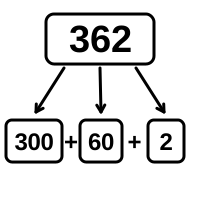
    Build 437 with 4 bags, 3 bundles, 7 beans. Write 437 and then write it stretched out: 400 + 30 + 7. Call this expanded form. Repeat with 582 (500 + 80 + 2) and 903 (900 + 3, explain that we skip the 0 tens). Then give the expanded form 200 + 60 + 1 and have the student build it and write 261.

    100-bean bags or paper flatsbundles of 10 craft sticksdried beanspapermarker
    15 min

    Practice

    Student writes expanded form for 146, 329, 570, 805, and 999, then writes standard form for 300 + 40 + 2, 700 + 9, 100 + 80, and 600 + 50 + 4. Build any that feel tricky with bags and bundles.

    paperpencil100-bean bags or paper flatsbundles of 10 craft sticksdried beans
    5 min

    Wrap-Up

    Ask, 'Why is 400 + 30 + 7 the same as 437? What does the plus sign mean here?' Student explains that we are putting the pieces together.

    Materials Needed

    100-bean bags or paper flatsbundles of 10 craft sticksdried beansindex cardsmarkerpaperpencil

    English Language Arts

    Use illustrations in Owl Moon to describe the setting and explain what the pictures tell us that the words do not (RL.2.7).

    Standards Addressed

    Activities

    15 min

    Read-Aloud

    Say: 'Last week we found the lesson in a story. This week we learn to read the pictures as carefully as the words.' Read Owl Moon by Jane Yolen, holding each page up long enough to look. On the page with the train whistle, ask, 'What do you see in the picture that the words never say?' (the size of the moon, the shadows, how bundled up the child is).

    Owl Moon by Jane Yolen, illustrated by John Schoenherr
    10 min

    Mini-Lesson

    Make a two-column chart: Words tell me / Pictures tell me. Fill in for the first page: Words: it was late one winter night. Pictures: deep snow, a farmhouse, a long shadow, no wind in the trees. Teach: good readers put the two columns together to understand the story.

    Chart paperMarkers
    15 min

    Guided Reading

    Your child goes back through Owl Moon as a picture hunt: find the hidden animals John Schoenherr tucked into the snow scenes (a raccoon, a fox, a mouse, deer). For each one ask, 'Does the text mention it? What does it tell us about the woods at night?'

    Owl Moon by Jane Yolen, illustrated by John Schoenherr
    15 min

    Writing Workshop

    Introduce text-evidence responses. Ask, 'How does the child feel about going owling?' Model an answer with the frame 'I think ___. In the text it says ___. In the picture I see ___.' and write it on a chart. Your child copies the frame into the writing folder.

    Chart paperMarkersWriting folderPencil
    10 min

    Phonics

    Introduce the prefix un-, which means not or the opposite of. Read and write: unhappy, untie, unlock, unfair, unpack, unkind, unsafe, undo, unable, unzip. Your child covers the prefix with a finger, reads the base word, then uncovers and reads the whole word.

    Index cardsMarker

    Materials Needed

    Owl Moon by Jane Yolen, illustrated by John SchoenherrChart paperMarkersWriting folderPencilIndex cards

    Science

    Students will test paper towels and other materials to decide which is best at absorbing a spill and explain the choice with data (2-PS1-2).

    This week's reading: Which Material Is Best?

    Standards Addressed

    Activities

    5 min

    Science Question of the Week

    Ask, 'How do we pick the right material for a job?' Remind your child that in Week 2 the sponge absorbed and the foil did not. Say, 'This week you are the tester. A company wants to know which towel to sell.' Write the words test, fair and best for the job on an index card.

    20 min

    Investigation: Which Towel Wins?

    Cut equal squares (about the size of your hand) from a paper towel, a napkin, a tissue, a coffee filter and a piece of newspaper. Pour exactly 2 spoons of water on a plate, lay one square on it for 10 seconds, lift it, and have your child count the spoons of water left on the plate. Repeat for each material and record in a chart. Talk about what made the test fair (same size, same water, same time). Support: test only three materials. Stretch: test each material twice and see if the results match.

    paper towelnapkintissuecoffee filternewspaperscissorsplatespooncup of waterpaper and pencil
    5 min

    Wrap-Up

    Ask, 'Which material is best for a spill? What is your evidence?' Your child answers in the form 'The ____ is best because it left only ____ spoons of water.'

    Materials Needed

    paper towelnapkintissuecoffee filternewspaperscissorsplatespooncup of waterindex cardpaper and pencil
    Open Monday on its own page
    Science

    Reading About Our World: Which Material Is Best?

    Read it aloud first while your child follows along. Then read it together, and let your child read the parts they can. Talk about the words in the word box.

    Things are made of materials. Wood, metal, plastic, cloth, glass and paper are all materials.

    Each material has properties. Metal is hard and strong. Cloth is soft and bends. Glass is clear, so you can see through it. Paper tears easily.

    People choose materials by their properties. A window is made of glass so light can come in. A raincoat is made of material that keeps water out. A pillow is filled with something soft.

    Scientists and engineers test materials to find the best one for a job. To make a test fair, they change only one thing. To find which paper towel soaks up the most water, you use the same amount of water for each towel.

    Which material would you choose to build a bridge for a toy car? Why?

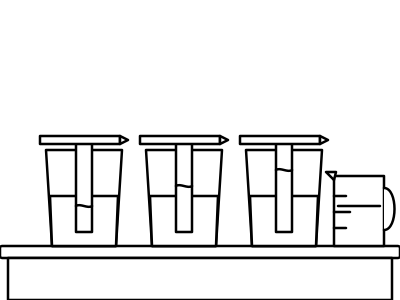
    Three paper towel strips hang into three cups with the same amount of water, to test which towel soaks up the most.

    Word box

    material:
    what something is made of
    property:
    something you can observe about a material, like hard or soft
    test:
    a way to find out something by trying it
    fair test:
    a test where only one thing is changed

    Questions

    1. Why are windows made of glass?
    2. What makes a test fair?
    3. Which material in the text is soft and bends?

    Weekly check

    Math

    Weekly Check

    • I can read and write numbers to 1000.
    • I can write a number in expanded form (like 400 + 60 + 2).
    1. Write 627 in expanded form.
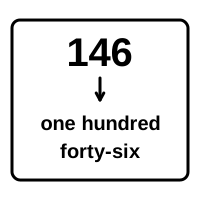
    2. Write 490 in words.
    3. 700 + 5 = ____
    4. Write the number: five hundred thirty-eight
    5. Write 814 in words.
    6. Draw 352 with squares, sticks and dots.

    ELA

    Weekly Check

    • I can use pictures to understand a story.
    • I can read and explain words with un-, re- and pre-.

    The Pond

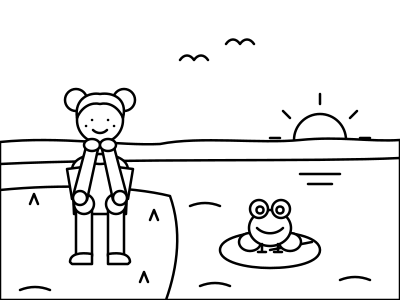
    Jada sat by the pond. She did not move. She just watched.

    Jada sits by a pond smiling with her chin in her hands, watching a frog on a lily pad as the sun goes down.
    1. What does the picture show that the words do not?
    2. How does Jada feel? Tell one clue from the picture.
    3. Unkind means ____.
    4. Redo means ____.
    5. Precook means ____.
    6. Add a prefix to fill to make a word that means fill again.

    Science

    Weekly Check

    • I can test materials to see which works best for a job.
    • I can explain a fair test (change only one thing).
    1. Which material is best for a raincoat?plasticpaper toweltissue
    2. Why?
    3. Which material is best to wipe up spilled milk?foila spongewax paper
    4. In a fair test you change only ____ thing.
    5. Nora tests three cloths. To be fair, what should she keep the same?

    Social Studies

    Weekly Check

    • I can explain what a right is and what a responsibility is.
    • I can match a right to a responsibility.
    1. A right is ____.
    2. A responsibility is ____.
    3. The right to be treated fairly goes with the responsibility to ____.treat others fairlywin every game
    4. The right to a clean park goes with the responsibility to ____.throw away my trashpick the flowers
    5. Which one is a responsibility?feed the petbe safe

    Specials

    Art · Elements of Art: Line, Shape & Pattern · All Specials

    This Week's Specials Page

    Art · Week 5

    I can make shape patterns.

    Look: Patterns repeat

    1. AB: circle, square, circle, square.
    2. ABB: circle, square, square, circle, square, square.
    3. ABC: circle, square, triangle, circle, square, triangle.

    Draw the next two shapes in each pattern.

    1. circle, triangle, circle, triangle, ____, ____ (AB)
    2. square, star, star, square, star, star, ____, ____ (ABB)
    3. heart, circle, square, heart, circle, square, ____, ____ (ABC)

    Pattern border.

    1. Cut shapes from paper or trace things at home (a cup, a block). Make your own pattern around this box. Write its name: AB, ABB or ABC.
    2. Is a leaf a geometric shape or an organic shape? Circle one.geometricorganic

    You need: paper, scissors, glue stick, crayons, a cup or block to trace

    How did it go? Great Okay Tricky

    Home Connection

    This week at home

    • Math

      Big numbers can be written many ways

    • ELA

      Pictures tell parts of the story too

    • Science

      Picking the best material for a job

    • Social Studies

      My rights come with my responsibilities

    Three things to celebrate this week

    We did blank of 4 activities.

    Suggested Daily Schedule

    8:30–9:00 AM30 minMorning Meeting / Calendar / Read-Aloud
    9:00–9:30 AM30 minPhonics / Word Study / Spelling
    9:30–10:15 AM45 minReading Workshop
    10:15–10:35 AM20 minSnack and Outdoor Play / Movement Break
    10:35–11:05 AM30 minWriting Workshop
    11:05–11:50 AM45 minMathematics
    11:50 AM–12:35 PM45 minLunch and Free Play
    12:35–1:05 PM30 minScience OR Social Studies (alternating)
    1:05–1:35 PM30 minSpecials: PE / Art / Music / Health (rotating)
    1:35–2:00 PM25 minIndependent Reading / Enrichment